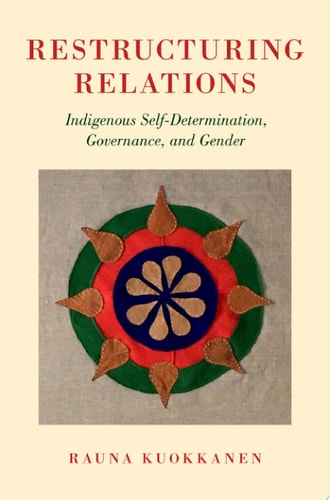
Restructuring Relations: Indigenous Self-Determination, Governance, and Gender
0
0
As an Amazon Associate and affiliate partner, Menrva Books earns from qualifying purchases. Learn more
Author Description
Adopted in 2007, the UN Declaration on the Rights of Indigenous Peoples establishes self-determination--including free, prior, and informed consent--as a foundational right and principle. Self-determination, both individual and collective, is among the most important and pressing issues for Indigenous women worldwide. Yet Indigenous women's interests have been overlooked in the formulation of Indigenous self-government, and existing studies of Indigenous self-government largely ignore issues of gender. As such, the current literature on Indigenous governance conceals patriarchal structures and power that create barriers for women to resources and participation in Indigenous societies. Drawing on Indigenous and feminist political and legal theory--as well as extensive participant interviews in Canada, Greenland, and Scandinavia-- this book argues that the current rights discourse and focus on Indigenous-state relations is too limited in scope to convey the full meaning of "self-determination" for Indigenous peoples. The book conceptualizes self-determination as a foundational value informed by the norm of integrity and suggests that Indigenous self-determination cannot be achieved without restructuring all relations of domination nor can it be secured in the absence of gender justice. As a foundational value, self-determination seeks to restructure all relations of domination, not only hegemonic relations with the state. Importantly, it challenges the opposition between "self-determination" and "gender" created and maintained by international law, Indigenous political discourse, and Indigenous institutions. Restructuring relations of domination further entails examining the gender regimes present in existing Indigenous self-government institutions, interrogating the relationship between Indigenous self-determination and gender violence, and considering future visions of Indigenous self-determination, such as rematriation of Indigenous governance and an independent st
Menrva's Summary
THE THESIS
This book investigates how the current discourse on Indigenous self-determination fails to account for gender justice and patriarchal structures within governance. Rauna Kuokkanen, a scholar in Indigenous studies, utilizes a synthesis of Indigenous and feminist political theory to argue that true self-determination requires the dismantling of all relations of domination. By analyzing the limitations of existing state-centric rights frameworks, the author proposes a model of self-determination grounded in the norm of integrity.
THE SCOPE MAP
What You Will Find
- Analysis of gender regimes within contemporary Indigenous self-government institutions
- Theoretical framework connecting self-determination to the concept of rematriation
- Comparative study of Indigenous governance models in Canada, Greenland, and Scandinavia
- Examination of the intersection between gender violence and political autonomy
Scope Limits
- Does not provide a comprehensive legal history of the UN Declaration on the Rights of Indigenous Peoples
- Does not focus on non-Arctic or non-North American Indigenous governance structures
THE AUTHORITY PERSPECTIVE
Scholars and practitioners in the field of Indigenous governance recognize this text as a critical intervention that bridges the gap between political theory and gender justice. Readers frequently note the academic density of the prose and the depth of the qualitative research conducted through participant interviews.
Page Count:
382
Publication Date:
2019-01-01
Publisher:
Oxford University Press
ISBN-10:
0190913304
ISBN-13:
9780190913304
Human rights
Governance
Feminist Theory
Sociology
Gender Studies
Comparative Politics
Public Policy
Community Tags
Similar Books