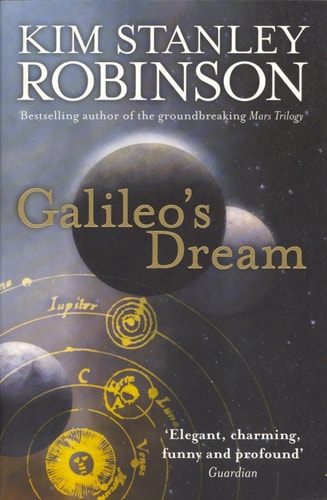
Galileo's Dream
0
0
As an Amazon Associate and affiliate partner, Menrva Books earns from qualifying purchases. Learn more
Author Description
The winner of every major science fiction award, Kim Stanley Robinson is a novelist who looks ahead with optimism even while acknowledging the steep challenges facing our planet and species: a clear-eyed realist who has not forgotten how to dream. His new novel offers his most audacious dream yet. At the heart of a brilliant narrative that stretches from Renaissance Italy to the moons of Jupiter is one man, the father of modern science: Galileo Galilei.To the inhabitants of the Jovian moons, Galileo is a revered figure whose actions will influence the subsequent history of the human race. From the summit of their distant future, a charismatic renegade named Ganymede travels to the past to bring Galileo forward in an attempt to alter history and ensure the ascendancy of science over religion. And if that means Galileo must be burned at the stake, so be it.Yet between his brief and jarring visitations to this future, Galileo must struggle against the ignorance and superstition of his own time. And it is here that Robinson is at his most brilliant, showing Galileo in all his contradictions and complexity. Robinson's Galileo is a tour de force of imaginative and historical empathy: the shining center around which the novel revolves. From Galileo's heresy trial to the politics of far-future Jupiter, from the canals of Venice to frozen, mysterious Europa, Robinson illuminates the parallels between a distant past and an even more remote future—in the process celebrating the human spirit and calling into question the convenient truths of our own moment in time.
Menrva's Summary
THE PULSE
Galileo Galilei finds his life and scientific pursuits interrupted by a mysterious figure from a distant future who seeks to manipulate the course of human history. As the father of modern science navigates the treacherous political and religious landscape of Renaissance Italy, he is periodically pulled into the future to witness the consequences of his discoveries on the moons of Jupiter. Galileo must reconcile his own intellectual curiosity and personal survival with the demands of a future civilization that views him as a pivotal, yet expendable, instrument for their own ideological agenda. The narrative alternates between the grounded, sensory details of 17th-century Italy and the speculative, high-concept environment of a future Jovian society.
INSIDE THE PAGES
- Dual-timeline narrative structure alternating between Renaissance Italy and a far-future Jovian system
- Detailed historical recreation of the Inquisition and Galileo's heresy trial
- Speculative exploration of the moons of Jupiter as colonized environments
- Philosophical examination of the conflict between empirical science and institutional dogma
- Character study of Galileo Galilei focusing on his personal contradictions and scientific rigor
- Use of time travel as a mechanism for historical intervention
- Integration of astronomical discovery and political intrigue
- Thematic focus on the long-term societal impact of scientific advancement
THE COLLECTIVE ECHO
This novel is regarded as a dense, ambitious synthesis of historical biography and speculative fiction that challenges the reader to consider the weight of scientific legacy. The narrative is noted for its meticulous attention to the political and religious pressures of the 17th century, which provides a stark contrast to the imaginative, high-tech future depicted on the moons of Jupiter. Readers often highlight the author's ability to humanize a historical icon while simultaneously exploring complex questions about the ethics of time manipulation and historical determinism. The pacing is deliberate, favoring intellectual exploration and atmospheric world-building over rapid-fire action sequences, which aligns with the author's established literary style.
Page Count:
0
Publication Date:
2009-10-01
Publisher:
HarperCollins UK
ISBN-10:
0007260326
ISBN-13:
9780007260324
Science Fiction
Fantasy
Historical Fiction
Adventure
Science Fiction
Biographical fiction
Time Travel
Community Tags
Similar Books