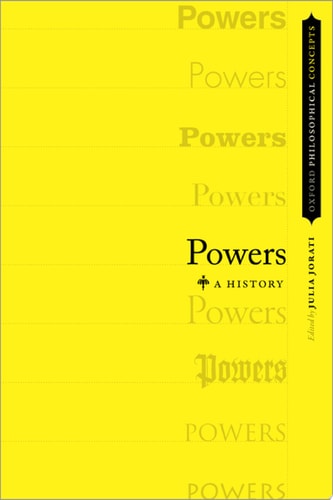
Powers: A History
0
0
As an Amazon Associate and affiliate partner, Menrva Books earns from qualifying purchases. Learn more
Author Description
Why does a wine glass break when you drop it, whereas a steel goblet does not? The answer may seem obvious: glass, unlike steel, is fragile. This is an explanation in terms of a power or disposition: the glass breaks because it possesses a particular power, namely fragility. Seemingly simple, such intrinsic dispositions or powers have fascinated philosophers for centuries. A power's central task is explaining why a thing changes in the ways that it does, rather than in other ways: powers should explain why an acorn turns into an oak tree, not a sunflower, or why fire burns wood, and wood can catch fire.This volume examines the twists and turns of the fascinating history of a difficult philosophical concept, focusing on the metaphysical sense of "powers"--that is, the powers that are invoked in the explanation of natural changes and activities. Scholars probe the views of thinkers from antiquity to the present day: Anaxagoras, Plato, the Stoics, Abelard, Anselm, Henry of Ghent, Gottfried Wilhelm Leibniz, Margaret Cavendish, Mary Shepherd, Immanuel Kant, Georg Wilhelm Friedrich Hegel, and numerous others. In addition, the volume contains four short reflection essays that examine the concept of powers from the perspective of disciplines other than philosophy, namely history of music, West African religions, history of chemistry, and history of art.The history of philosophy brims with controversies surrounding the concept of power, and these controversies have not diminished--particularly as potentialities or powers see a revival in contemporary analytic metaphysics. Hence, telling the history of philosophical theories of powers means exploring the trajectory of a concept whose importance to the past and present of philosophy can hardly be overstated.
Menrva's Summary
THE THESIS
This volume investigates the historical evolution and metaphysical significance of the concept of powers as explanatory tools for natural change and activity. Editor Julia Jorati compiles a series of scholarly essays that trace the development of dispositional theories from ancient Greek thought through contemporary analytic metaphysics. By examining the arguments of diverse thinkers, the text seeks to clarify how intrinsic powers function as the underlying causes of physical phenomena.
THE SCOPE MAP
What You Will Find
- Historical analysis of philosophical figures including Anaxagoras, Plato, the Stoics, Leibniz, and Kant.
- Interdisciplinary reflection essays covering music history, West African religions, chemistry, and art history.
- A comprehensive overview of the metaphysical debate surrounding potentiality and disposition.
Scope Limits
- The text focuses primarily on the metaphysical definition of powers rather than purely scientific or empirical definitions.
- It does not provide an exhaustive survey of every minor historical figure who has touched upon the concept.
THE AUTHORITY PERSPECTIVE
Experts identify this volume as a rigorous contribution to the Oxford Philosophical Concepts series, suitable for advanced students and scholars of metaphysics. Readers frequently note the academic density of the prose, which demands a strong foundational knowledge of historical philosophical discourse.
Page Count:
338
Publication Date:
2021-05-14
Publisher:
Oxford University Press
ISBN-10:
0190925515
ISBN-13:
9780190925512
Philosophy
Non-Fiction
Philosophy history
Academic
Metaphysics
Community Tags
Other Editions(2)

Similar Books