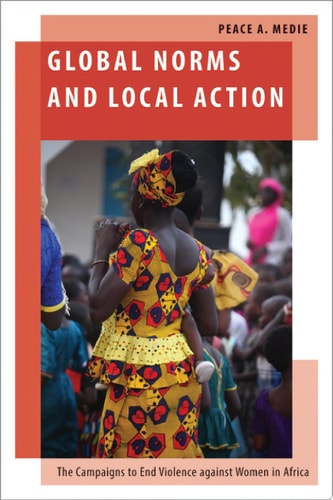
Global Norms and Local Action: The Campaigns to End Violence against Women in Africa
0
0
As an Amazon Associate and affiliate partner, Menrva Books earns from qualifying purchases. Learn more
Author Description
Violence against women has been a focus of transnational advocacy networks since the early 1980s, and the United Nations has, in intervening years, passed a series of resolutions to condemn, prevent, investigate, and punish this violence. Member states have committed to implementing this agenda. Yet, despite this buy-in at the global level, implementation at the domestic level remains uneven. Scholars have found that states are more likely to translate global standards into national laws when pressured by women's movements and international organizations. However, a dearth of research on the implementation — at the national and street-levels — of these international women's rights norms hampers an understanding of what happens after states pass laws. In Africa, where most states have not prioritized the prevention of violence against women, and the majority of perpetrators act with impunity, there is a major implementation gap. This gap is acute in some post-conflict countries on the continent. Thus, despite the presence of laws on various forms of violence against women in most African countries, justice remains inaccessible to most victims. In Global Norms and Local Action, Peace A. Medie studies the domestic implementation of international norms by examining how and why two post-conflict states in Africa, Liberia and Côte d'Ivoire, have differed in their responses to rape and domestic violence. Specifically, she looks at the roles of the United Nations and women's movements in the establishment of specialized criminal justice sector agencies, and the referral of cases for prosecution. She argues that variation in implementation in Liberia and Côte d'Ivoire can be explained by the levels of international and domestic pressures that states face and by the favorability of domestic political and institutional conditions. Medie's study is based on interviews with over 300 policymakers, bureaucrats, staff at the UN and NGOs, police officers, and survivors of domestic violence.
Menrva's Summary
THE THESIS
This book investigates why domestic implementation of international norms regarding violence against women varies significantly between post-conflict states in Africa. Peace A. Medie, a scholar in international relations and gender studies, utilizes a comparative political framework to analyze the disconnect between global policy adoption and local enforcement. By examining the specific political and institutional conditions within Liberia and Côte d'Ivoire, she argues that the effectiveness of these norms depends heavily on the interplay between international pressure and domestic advocacy.
THE SCOPE MAP
What You Will Find
- Comparative analysis of post-conflict legal implementation in Liberia and Côte d'Ivoire
- Examination of specialized criminal justice sector agencies and case referral mechanisms
- Assessment of the influence exerted by the United Nations and local women's movements
- Qualitative data derived from over 300 interviews with policymakers, police, and survivors
Scope Limits
- Focus is restricted to two specific African nations rather than a continent-wide survey
- Analysis centers primarily on rape and domestic violence rather than all forms of gender-based violence
THE AUTHORITY PERSPECTIVE
Experts in international relations and gender studies recognize this work as a significant contribution to the study of norm diffusion and implementation gaps. Readers frequently note the academic rigor of the research and the clarity with which the author navigates complex political environments.
Page Count:
252
Publication Date:
2020-01-01
Publisher:
Oxford University Press
ISBN-10:
0190922982
ISBN-13:
9780190922986
Sociology
International relations
Human rights
Gender Studies
Community Tags
Similar Books