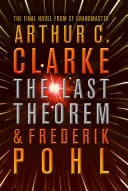
The Last Theorem
0
0
As an Amazon Associate and affiliate partner, Menrva Books earns from qualifying purchases. Learn more
Author Description
The Final Work From The Brightest Star In Science Fiction’s Galaxy. Arthur C Clarke, Who Predicted The Advent Of Communication Satellites And Author Of 2001: A Space Odyssey Completes A Lifetime Career In Science Fiction With A Masterwork.
Menrva's Summary
THE PULSE
A brilliant mathematician finds himself at the center of a global crisis when his discovery of a proof for Fermat's Last Theorem attracts the attention of extraterrestrial observers. The protagonist, Ranjit Subramanian, must navigate the complex intersection of human scientific advancement and the scrutiny of an advanced alien civilization that monitors Earth's progress. As the world teeters on the brink of technological transformation, Ranjit faces opposition from political factions and military interests seeking to weaponize his findings. The narrative unfolds through a blend of rigorous scientific inquiry and geopolitical tension, reflecting the authors' characteristic focus on the implications of human evolution in a vast, indifferent universe.
INSIDE THE PAGES
- Exploration of the historical and mathematical significance of Fermat's Last Theorem
- Integration of real-world scientific concepts and technological forecasting
- Examination of the potential impact of extraterrestrial contact on human society
- Portrayal of geopolitical maneuvering in a near-future setting
- Focus on the ethical responsibilities of scientists and inventors
- Use of multiple perspectives to illustrate the global scale of the conflict
- Emphasis on the transition from terrestrial limitations to interstellar potential
- Philosophical inquiry into the nature of human intelligence and progress
THE COLLECTIVE ECHO
This novel serves as a final testament to the collaborative spirit of two titans of the genre, blending Clarke's penchant for grand-scale technological speculation with Pohl's grounded approach to social dynamics. Readers often highlight the book's dedication to scientific accuracy and its contemplative tone regarding humanity's place in the cosmos. While some critics note the pacing reflects the authors' later-career styles, the work is frequently cited for its intellectual depth and thematic consistency with their earlier contributions to science fiction. The narrative provides a fitting conclusion to a legacy defined by the exploration of the unknown and the possibilities of the future.
Page Count:
336
Publication Date:
2008-08-05
Publisher:
HarperCollins
ISBN-10:
0007308140
ISBN-13:
9780007308149
Science Fiction
Subjects
Fermats last theorem
Mathematics
Physicists
Science Fiction
Fiction
Space vehicles
Mathematicians
Speculative Fiction
Propulsion systems
Community Tags
Similar Books