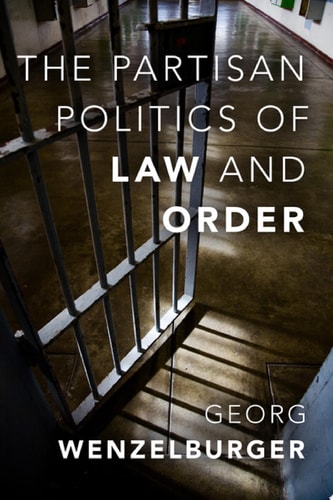
The Partisan Politics of Law and Order
0
0
As an Amazon Associate and affiliate partner, Menrva Books earns from qualifying purchases. Learn more
Author Description
Cover -- Series -- The Partisan Politics Of Law And Order -- Copyright -- Dedication -- Contents -- Preface -- Acknowledgments -- 1 Introduction -- 1.1 The Three Main Arguments In Brief -- 1.2 Research Design, Methods, And Data -- 1.3 Putting The Partisan Politics Of Law And Order In Context -- 1.3.1 General Pressures: Crime, Unemployment, Globalization, And The Public Mood -- 1.3.2 Proximate Context And The Impact Of Institutions -- 1.3.3 Political Actors And Party Politics -- 1.3.4 Policy Feedback 1.3.5 Putting The Existing Literature In Causal Order: A Conceptual Framework For The Explanation Of Law And Order Policies -- 1.4 Outline Of The Book And Chapter Preview -- 2 A Theoretical Framework Of The Partisan Politics Of Law And Order -- 2.1 Setting The Law And Order Agenda: Party Politics And Issue Competition -- 2.1.1 More Valence Than Positional: The Issue Of Law And Order -- 2.1.2 Salience And Issue Competition -- 2.1.3 Party System Configurations And Issue Competition On Law And Order -- 2.1.4 Expectations On Party Behavior 2.2 From Issue Competition To Outputs: How Government Participation And Institutional Constraints Affect Policies -- 2.3 Law And Order And Policy Feedback -- 2.4 Summary And Discussion Of Hypotheses And The Theoretical Model -- 3 Patterns Of Law And Order Policies In 20 Western Industrialized Countries: A Quantitative Analysis -- 3.1 Setting The Agenda: Issue Competition On Law And Order -- 3.1.1 Variables And Methods -- 3.1.2 Empirical Patterns Of Issue Competition On Law And Order -- 3.2 From Agenda To Policies I: Patterns Of Law And Order Spending -- 3.2.1 Variables And Methods 3.2.2 Empirical Patterns Of Law And Order Spending -- 3.3 From Agenda To Policies Ii: Patterns Of Law And Order Legislation In Four Western European Countries -- 3.3.1 Variables And Methods -- 3.3.2 Empirical Patterns Of Law And Order Legislation -- 3.4 Summary: Findings Of The Quantitative Analyses -- 4 Law And Order Policies And Third Way Social Democrats -- 4.
Menrva's Summary
THE THESIS
This book investigates how partisan competition and political ideology shape the development and implementation of law and order policies across Western democracies. Georg Wenzelburger, a scholar in political science, utilizes a comparative framework to analyze how different political parties—particularly Social Democrats and conservative factions—approach crime control and criminal justice legislation. The work argues that law and order is not merely a response to crime rates but a strategic issue used by parties to gain electoral advantage within specific institutional constraints.
THE SCOPE MAP
What You Will Find
- A comparative analysis of law and order policies across 20 Western industrialized countries.
- A theoretical model linking party competition, government participation, and institutional constraints to policy outputs.
- Quantitative data on public spending and legislative trends related to criminal justice.
Scope Limits
- The analysis focuses primarily on Western industrialized nations, excluding non-Western political systems.
- The study does not provide a comprehensive history of individual criminal justice systems but focuses on the political drivers of policy change.
THE AUTHORITY PERSPECTIVE
Experts identify this work as a rigorous contribution to the study of comparative public policy and political behavior. Readers frequently note the academic density of the prose, which is well-suited for researchers and students of political science seeking a structured framework for understanding criminal justice policy.
Page Count:
256
Publication Date:
2020-01-01
Publisher:
Oxford University Publication,
ISBN-10:
0190920491
ISBN-13:
9780190920494
Political Aspects
Criminology
Government
Law
Public Policy
Sociology
Community Tags
Other Editions(2)
Similar Books















Reader Comments
Share Your Thoughts
No comments yet. Be the first to share your thoughts!