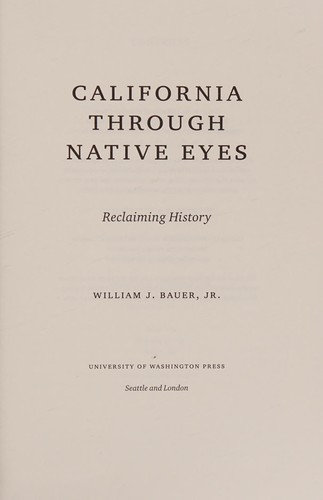
California Through Native Eyes
0
0
As an Amazon Associate and affiliate partner, Menrva Books earns from qualifying purchases. Learn more
Author Description
Most California histories begin with the arrival of the Spanish missionaries in the late eighteenth century and skip to the Gold Rush of 1849. Noticeably absent from these stories are the perspectives and experiences of the people who lived on the land long before European settlers arrived. Historian William Bauer seeks to correct that oversight through an approach that tells California history strictly through Native perspectives. Using oral histories of Concow, Pomo, and Paiute workers, taken as part of a New Deal federal works project, Bauer reveals how Native peoples have experienced and interpreted the history of the land we now call California. Combining these oral histories with creation myths and other oral traditions, he demonstrates the importance of sacred landscapes and animals and other nonhuman actors to the formation of place and identity. He also examines tribal stories of ancestors who prophesized the coming of white settlers and uses their recollections of the California Indian Wars to counteract popular narratives that downplay Native resistance. The result challenges the "California story" and enriches it with new voices and important points of view.--Provided by publisher.
Menrva's Summary
THE THESIS
This book challenges conventional narratives of California history by centering the voices and experiences of its Indigenous peoples. William J. Bauer Jr., a historian, aims to rectify the common omission of Native perspectives in historical accounts, which often begin with Spanish colonization or the Gold Rush. By integrating oral histories from Concow, Pomo, and Paiute workers, creation myths, and other traditional narratives, Bauer illuminates how Native peoples have perceived and shaped the history of the land. The work also incorporates tribal accounts of prophecies concerning European arrival and recollections of the California Indian Wars to counter narratives that minimize Indigenous resistance.
THE SCOPE MAP
- Oral histories of Concow, Pomo, and Paiute workers collected during a New Deal federal works project.
- Analysis of creation myths and oral traditions to understand Native interpretations of place and identity.
- Examination of tribal prophecies regarding the arrival of European settlers.
- Counter-narratives to popular accounts of the California Indian Wars, highlighting Native resistance.
- A re-evaluation of California history through Indigenous viewpoints.
THE AUTHORITY PERSPECTIVE
This work is recognized for its significant contribution to California historiography by foregrounding Indigenous perspectives, which are often marginalized in traditional accounts. By utilizing a rich array of oral histories and traditional narratives, Bauer provides a nuanced understanding of Native experiences and interpretations of historical events. The book is likely to be valued by scholars and students of Native American studies and California history for its corrective approach and the depth of its research.
Page Count:
165
Publication Date:
2016-01-01
ISBN-10:
0295998350
ISBN-13:
9780295998350
History
Non-Fiction
Oral History
California history
Community Tags
Similar Books