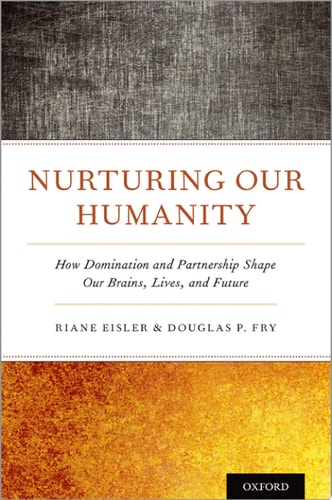
Nurturing Our Humanity
0
0
As an Amazon Associate and affiliate partner, Menrva Books earns from qualifying purchases. Learn more
Author Description
Nurturing Our Humanity offers a new perspective on our personal and social options in today's world, showing how we can build societies that support our great human capacities for consciousness, caring, and creativity. It brings together findings--largely overlooked--from the natural and social sciences debunking the popular idea that we are hard-wired for selfishness, war, rape, and greed. Its new approach reveals connections between disturbing trends like climate change denial and regressions to strongman rule. Moving past right vs. left, religious vs. secular, Eastern vs. Western, and other familiar categories that do not include our formative parent-child and gender relations, it looks at where societies fall on the partnership-domination scale. On one end is the domination system that ranks man over man, man over woman, race over race, and man over nature. On the other end is the more peaceful, egalitarian, gender-balanced, and sustainable partnership system. Nurturing Our Humanity explores how behaviors, values, and socio-economic institutions develop differently in these two environments, documents how this impacts nothing less than how our brains develop, examines cultures from this new perspective (including societies that for millennia oriented toward partnership), and proposes actions supporting the contemporary movement in this more life-sustaining and enhancing direction. It shows how through today's ever more fearful, frenzied, and greed-driven technologies of destruction and exploitation, the domination system may lead us to an evolutionary dead end. A more equitable and sustainable way of life is biologically possible and culturally attainable: we can change our course.
Menrva's Summary
THE THESIS
This book investigates whether human nature is inherently predisposed toward violence and greed or if social structures can be engineered to foster cooperation and sustainability. Douglas P. Fry, an anthropologist, and Riane Eisler, a systems scientist, synthesize data from the natural and social sciences to challenge the biological determinism often used to justify war and inequality. They propose a framework centered on the 'partnership-domination' scale, arguing that societal health depends on how institutions prioritize gender equality and care-based values over hierarchical control.
THE SCOPE MAP
What You Will Find
- The partnership-domination social systems framework
- Analysis of how socio-economic institutions influence neurobiological development
- Comparative studies of cultures oriented toward egalitarianism versus those oriented toward domination
- Strategies for transitioning toward life-sustaining societal structures
Scope Limits
- The text does not provide a comprehensive history of every global civilization
- It does not offer a technical manual for specific legislative policy implementation
THE AUTHORITY PERSPECTIVE
Scholars and readers often note the interdisciplinary breadth of the text, which bridges the gap between evolutionary biology and political sociology. Experts highlight this as a significant contribution to the study of social systems, particularly for its focus on the formative impact of gender relations on broader societal outcomes.
Page Count:
320
Publication Date:
2019-01-01
Publisher:
Oxford University Press
ISBN-10:
0190935731
ISBN-13:
9780190935733
Sociology
Social Science
Anthropology
Community Tags
Other Editions(2)
Similar Books