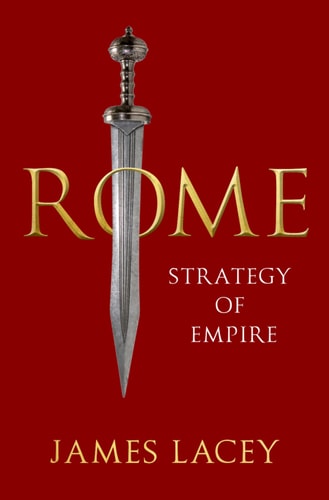
Rome: Strategy of Empire
0
0
As an Amazon Associate and affiliate partner, Menrva Books earns from qualifying purchases. Learn more
Author Description
The first work to lay out Roman strategic thinking from its start under Augustus until its final demise in 476 CEFrom Octavian's victory at Actium (31 bc) to its traditional endpoint in the West (476), the Roman Empire lasted a solid 500 years—an impressive number by any standard, and fully one-fifth of all recorded history. In fact, the decline and final collapse of the Roman Empire took longer than most other empires even existed. Any historian trying to unearth the grand strategy of the Roman Empire must, therefore, always remain cognizant of the time scale, in which she is dealing. Although the pace of change in the Roman era never approached that of the modern era, it was not an empire in stasis. While the visible trappings may have changed little, the challenges Rome faced at its end were vastly different than those faced by Augustus and the Julio-Claudians. Over the centuries, the Empire's underlying economy, political arrangements, military affairs, and, most importantly, the myriad of external threats it faced were in constant flux, making adaptability to changing circumstances as important to Roman strategists as it is to strategists of the modern era.Yet the very idea of Rome having a grand strategy, or what it might be, had not concerned historians until Edward Luttwak's The Grand Strategy of the Roman Empire appeared forty years ago. Although this pioneering work generated much debate, it failed to win over many ancient historians, in part because of its heavy emphasis on military force and its neglect of considerations of diplomacy, economics, politics, culture, and the changing nature of the threats that confronted Rome.By employing an expansive definition of strategy and by focusing much of the narrative on crucial historical moments and the personalities involved, James Lacey provides a comprehensive, persuasive, and engaging account of the rise and fall of the Roman Empire. It assimilates the most recent work of classical historians and archaeologi
Menrva's Summary
THE THESIS
This work investigates the existence and evolution of Roman grand strategy from the reign of Augustus to the fall of the Western Empire in 476 CE. James Lacey, a military historian, challenges previous narrow interpretations of Roman statecraft by arguing that Roman leaders maintained a sophisticated, adaptive approach to power. By integrating military, economic, diplomatic, and political factors, the author demonstrates how Rome navigated five centuries of shifting external threats and internal structural changes.
THE SCOPE MAP
What You Will Find
- A chronological analysis of Roman strategic decision-making from 31 BCE to 476 CE.
- An expansive definition of strategy that incorporates diplomacy, economics, and cultural influence.
- Case studies focusing on pivotal historical moments and the specific personalities of Roman leaders.
Scope Limits
- The text does not provide a comprehensive military history of every Roman campaign or battle.
- It focuses primarily on the Western Empire and does not offer an exhaustive analysis of the Eastern Roman Empire's later survival.
THE AUTHORITY PERSPECTIVE
Experts recognize this work as a significant counter-argument to earlier, military-centric models of Roman strategy. Readers frequently note the accessible prose style, which balances academic rigor with a clear narrative focus on the complexities of imperial governance.
Page Count:
444
Publication Date:
2022-01-01
Publisher:
Oxford University Press
ISBN-10:
0190937726
ISBN-13:
9780190937720
History
Ancient History
Strategy
Ancient - Rome
Military History
Community Tags
Similar Books