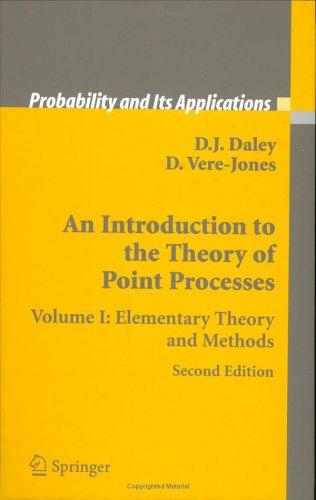
An Introduction to the Theory of Point Processes
0
0
As an Amazon Associate and affiliate partner, Menrva Books earns from qualifying purchases. Learn more
Author Description
Point processes and random measures find wide applicability in telecommunications, earthquakes, image analysis, spatial point patterns, and stereology, to name but a few areas. The authors have made a major reshaping of their work in their first edition of 1988 and now present their Introduction to the Theory of Point Processes in two volumes with sub-titles "Elementary Theory and Models" and "General Theory and Structure". Volume One contains the introductory chapters from the first edition, together with an informal treatment of some of the later material intended to make it more accessible to readers primarily interested in models and applications. The main new material in this volume relates to marked point processes and to processes evolving in time, where the conditional intensity methodology provides a basis for model building, inference, and prediction. There are abundant examples whose purpose is both didactic and to illustrate further applications of the ideas and models that are the main substance of the text. Volume Two returns to the general theory, with additional material on marked and spatial processes. The necessary mathematical background is reviewed in appendices located in Volume One. Daryl Daley is a Senior Fellow in the Centre for Mathematics and Applications at the Australian National University, with research publications in a diverse range of applied probability models and their analysis; he is co-author with Joe Gani of an introductory text in epidemic modelling. David Vere-Jones is an Emeritus Professor at Victoria University of Wellington, widely known for his contributions to Markov chains, point processes, applications in seismology.
Menrva's Summary
THE THESIS
This volume introduces the fundamental concepts and models of point processes and random measures, essential tools for analyzing phenomena that occur randomly in space or time. The authors, Daryl Daley and David Vere-Jones, draw upon their extensive expertise to present a comprehensive overview, making complex theories accessible through numerous examples and applications in fields like telecommunications, seismology, and image analysis. Volume One focuses on elementary theory and models, with new material on marked point processes and time-evolving processes, aiming to be particularly useful for readers focused on practical applications. Mathematical prerequisites are reviewed in appendices to ensure a broad audience can engage with the material.
THE SCOPE MAP
- Introduction to point processes and random measures.
- Coverage of applications in telecommunications, earthquakes, image analysis, spatial point patterns, and stereology.
- Detailed treatment of elementary theory and models.
- Inclusion of informal treatments of later material for accessibility.
- New material on marked point processes.
- New material on processes evolving in time, using conditional intensity methodology.
- Abundant examples for didactic purposes and to illustrate applications.
- Review of necessary mathematical background in appendices.
THE AUTHORITY PERSPECTIVE
The first edition of this work, published in 1988, was significantly reshaped for its subsequent publication. This revised 'Volume One: Elementary Theory and Models' is designed to be more approachable for readers primarily interested in models and applications, incorporating new material on marked point processes and time-evolving processes. The inclusion of abundant examples and accessible explanations of mathematical prerequisites aims to facilitate understanding for a wide range of students and researchers in applied probability and related fields.
Page Count:
471
Publication Date:
2002-01-01
ISBN-10:
0387955410
Science
Non-Fiction
Probability
Applied Mathematics
Stochastic processes
Community Tags
Similar Books