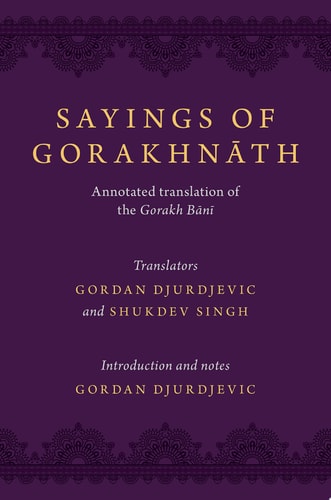
Sayings of Gorakhnath: Annotated Translation of the Gorakh Bani
0
0
As an Amazon Associate and affiliate partner, Menrva Books earns from qualifying purchases. Learn more
Author Description
Sayings of Gorakhnath presents a translation of late-medieval texts in Old Hindi, traditionally attributed to one of the founders of the Order of Nath Yogis. The Naths are associated with the creation and development of hatha yoga, with important historical and ideological links to Hindu tantra and alchemy. The texts gathered in this collection on the one hand provide a criticism of religious authority based on external knowledge lacking personal experience, while on the other hand they celebrate the path of yoga and its methods of engagement with the subtle body and its centres of occult energy and miraculous powers.The ultimate goal of the style of yoga described in the Sayings of Gorakhnath concerns the attainment of immortality and divinization of its adepts. This is achieved by redirecting the trajectory of the seminal fluid, which in the process transforms into the elixir, the amrt. In order to accomplish that goal, a regime of yogic practices is suggested, consisting of the assumption of a steady posture, breathing exercises, mantra chanting, and meditation. Djudjevic and Singh's translations are preceded by an introduction and accompanied by notes, which contextualize and elucidate the subject matter.
Menrva's Summary
THE THESIS
This work investigates the foundational teachings and ideological framework of the Nath Yogi tradition as expressed in the late-medieval Gorakh Bani. Gordan Djurdjevic and Shukdev Singh, both scholars of religious studies and Indian traditions, provide an annotated translation of these Old Hindi texts. They argue that the Gorakh Bani serves as both a critique of institutional religious authority and a manual for the attainment of immortality through specific yogic practices.
THE SCOPE MAP
What You Will Find
- Annotated translations of late-medieval Old Hindi texts attributed to Gorakhnath
- Detailed explanations of hatha yoga, tantra, and alchemical concepts
- Contextual analysis of the subtle body and occult energy centers
- Scholarly introduction and notes on the Order of Nath Yogis
Scope Limits
- The text does not provide a comprehensive history of all Indian ascetic movements
- It does not offer a modern instructional guide for practicing these techniques without traditional guidance
THE AUTHORITY PERSPECTIVE
Scholars and practitioners of Indian philosophy frequently cite this volume as a critical resource for understanding the historical development of hatha yoga. Readers often note the academic density of the prose, which effectively bridges the gap between historical linguistics and spiritual practice.
Page Count:
237
Publication Date:
2019-01-01
Publisher:
Oxford University Press
ISBN-10:
0190935103
ISBN-13:
9780190935108
Philosophy
History
Religion
Spirituality
Hinduism
Yoga
Tantra
Community Tags
Similar Books