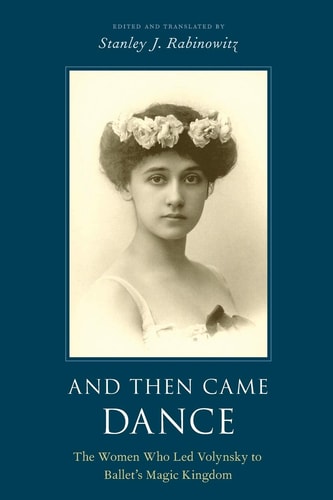
And Then Came Dance: The Women Who Led Volynsky to Ballet's Magic Kingdom
0
0
As an Amazon Associate and affiliate partner, Menrva Books earns from qualifying purchases. Learn more
Author Description
Presenting for the first time Akim Volynsky's (1861-1926) pre-balletic writings on Leonardo da Vinci, Fyodor Dostoevsky, Otto Weininger, and on such illustrious personalities as Zinaida Gippius, Ida Rubinstein, and Lou Andreas-Salome, And Then Came Dance provides new insight into the origins of Volynsky's life-altering journey to become Russia's foremost ballet critic. A man for whom the realm of art was largely female in form and whose all-encompassing image of woman constituted the crux of his aesthetic contemplation that crossed over into the personal and libidinal, Volynsky looks ahead to another Petersburg-bred high priest of classical dance, George Balanchine. With an undeniable proclivity toward ballet's female component, Volynsky's dance writings, illuminated by examples of his earlier gendered criticism, invite speculation on how truly ground-breaking and forward-looking this critic is.
Menrva's Summary
THE THESIS
This work investigates the intellectual evolution of Akim Volynsky, questioning how his early aesthetic and gendered philosophies regarding literature and art informed his eventual role as a foundational figure in Russian ballet criticism. Stanley J. Rabinowitz, a scholar of Russian literature and culture, utilizes a collection of previously untranslated or unexamined pre-balletic writings to construct this analysis. By tracing Volynsky's fixation on the female form across his critiques of Dostoevsky, da Vinci, and various historical figures, the author argues that Volynsky's transition to dance criticism was a logical extension of his lifelong obsession with the feminine aesthetic. The book positions Volynsky as a critical precursor to later choreographic innovators like George Balanchine.
THE SCOPE MAP
What You Will Find
- Analysis of Volynsky's early writings on Leonardo da Vinci, Fyodor Dostoevsky, and Otto Weininger.
- Examination of the influence of figures such as Zinaida Gippius, Ida Rubinstein, and Lou Andreas-Salome on Volynsky's aesthetic development.
- A comparative study linking Volynsky's critical framework to the later work of George Balanchine.
- Exploration of the intersection between gendered philosophy and art criticism in early 20th-century Russia.
Scope Limits
- The text focuses primarily on the intellectual origins of Volynsky's work rather than providing a comprehensive biography of his entire life.
- It does not offer a technical manual on ballet choreography or performance history outside of the context of Volynsky's critical reception.
THE AUTHORITY PERSPECTIVE
Scholars and dance historians identify this text as a significant contribution to the understanding of the intellectual climate surrounding the Russian ballet tradition. Readers frequently note the academic density of the prose, which assumes a foundational knowledge of Russian cultural history and aesthetic theory.
Page Count:
296
Publication Date:
2019-08-27
Publisher:
Oxford University Press
ISBN-10:
0190943378
ISBN-13:
9780190943370
Biography
Cultural Anthropology
In literature
Literary Criticism
Dance
Humanities
Art History
In art
Russian History
Ballet
Dance History
Community Tags
Similar Books