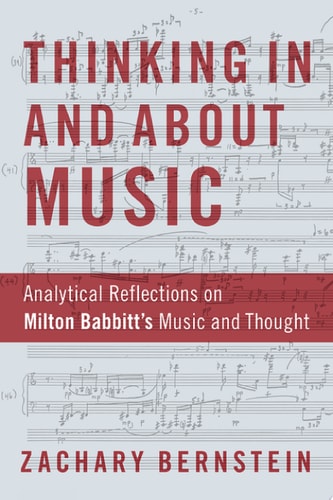
Thinking In and About Music: Analytical Reflections on Milton Babbitt's Music and Thought
0
0
As an Amazon Associate and affiliate partner, Menrva Books earns from qualifying purchases. Learn more
Author Description
Milton Babbitt (1916-2011) was, at once, one of the century's foremost composers and a founder of American music theory. These two aspects of his creative life--"thinking in" and "thinking about" music, as he would put it--nourished each other. Theory and analysis inspired fresh compositional ideas, and compositional concerns focused theoretical and analytical inquiry. Accordingly, this book undertakes an excavation of the sources of his theorizing as a guide to analysis of his music. In Thinking In and About Music, author Zachary Bernstein shows how Babbitt's idiosyncratic synthesis of ideas from Heinrich Schenker, analytic philosophy, and cognitive science--at least as much as more obviously relevant predecessors such as Arnold Schoenberg--provide insight into his aesthetics and compositional technique. At the same time, a close look at his music reveals a host of concerns unaccounted for in his theories, some of which seem to directly contradict theoretical expectations. Bernstein argues, therefore, that new analytical models are needed to complement those suggested by Babbitt's theories. Departing from the serial logic of most previous work on the subject--and in an attempt to discuss Babbitt's music as it is actually heard rather than just deciphered--the book brings to bear theories of gesture and embodiment, rhetoric, text setting, and temporality. The result is a richly multi-faceted look at one of the twentieth century's most fascinating musical minds.
Menrva's Summary
THE THESIS
This book investigates the symbiotic relationship between Milton Babbitt's compositional practice and his theoretical frameworks to determine how they inform the analysis of his music. Zachary Bernstein, a scholar of music theory, examines the intersection of Babbitt's creative output and his intellectual contributions to the field. By synthesizing influences from analytic philosophy, cognitive science, and Schenkerian analysis, the author constructs a new methodology for interpreting Babbitt's work. The text argues that traditional serial analysis is insufficient for understanding the auditory experience of Babbitt's compositions, necessitating a broader analytical approach.
THE SCOPE MAP
What You Will Find
- Analysis of Milton Babbitt's compositional techniques and theoretical writings.
- Integration of theories regarding gesture, embodiment, rhetoric, and temporality.
- Examination of the influence of Heinrich Schenker and analytic philosophy on Babbitt's work.
- Comparative study between theoretical expectations and actual musical output.
Scope Limits
- The book does not provide a comprehensive biography of Babbitt's life outside of his musical and theoretical development.
- It does not focus exclusively on serialism, intentionally moving beyond that singular analytical framework.
THE AUTHORITY PERSPECTIVE
Experts recognize this work as a significant contribution to the study of twentieth-century music theory, particularly for its attempt to bridge the gap between abstract theory and the listener's experience. Scholars frequently note the academic density of the prose, which is intended for readers with a strong background in music theory and analysis.
Page Count:
319
Publication Date:
2021-01-01
Publisher:
Oxford University Press
ISBN-10:
0190949252
ISBN-13:
9780190949259
Biography
Criticism history
Academic
Music theory
Composition
Music Technology
Humanities
Musicology
Biography Autobiography
English
English & College Success
Community Tags
Similar Books