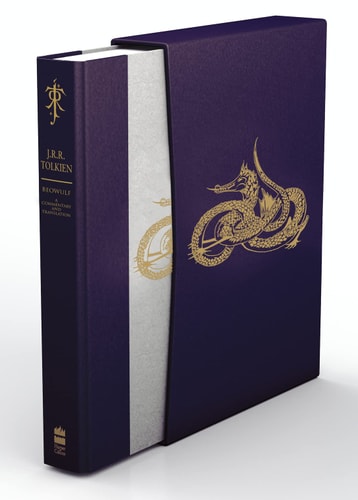
Beowulf: A Translation and Commentary, Together with Sellic Spell
0
0
As an Amazon Associate and affiliate partner, Menrva Books earns from qualifying purchases. Learn more
Author Description
The translation of Beowulf by J.R.R. Tolkien was an early work, very distinctive in its mode, completed in 1926: he returned to it later to make hasty corrections, but seems never to have considered its publication. This edition is twofold, for there exists an illuminating commentary on the text of the poem by the translator himself, in the written form of a series of lectures given at Oxford in the 1930s; and from these lectures a substantial selection has been made, to form also a commentary on the translation in this book. From his creative attention to detail in these lectures there arises a sense of the immediacy and clarity of his vision. It is as if he entered into the imagined past: standing beside Beowulf and his men shaking out their mail-shirts as they beached their ship on the coast of Denmark, listening to the rising anger of Beowulf at the taunting of Unferth, or looking up in amazement at Grendel’s terrible hand set under the roof of Heorot. But the commentary in this book includes also much from those lectures in which, while always anchored in the text, he expressed his wider perceptions. He looks closely at the dragon that would slay Beowulf ‘snuffling in baffled rage and injured greed when he discovers the theft of the cup’; but he rebuts the notion that this is ‘a mere treasure story’, ‘just another dragon tale’. He turns to the lines that tell of the burying of the golden things long ago, and observes that it is ‘the feeling for the treasure itself, this sad history’ that raises it to another level. ‘The whole thing is sombre, tragic, sinister, curiously real. The “treasure” is not just some lucky wealth that will enable the finder to have a good time, or marry the princess. It is laden with history, leading back into the dark heathen ages beyond the memory of song, but not beyond the reach of imagination.’ Sellic Spell, a ‘marvellous tale’, is a story written by Tolkien suggesting what might have been the form and style of an Old English folk-tale.
Menrva's Summary
THE THESIS
*This volume investigates the linguistic and cultural depth of the Old English epic Beowulf through the dual lens of J.R.R. Tolkien’s prose translation and his scholarly lectures.* The work presents Tolkien’s 1926 translation alongside a curated selection of his Oxford lectures from the 1930s, which provide a rigorous philological and imaginative framework for understanding the poem’s historical and mythic significance. By analyzing the text as both a historical artifact and a living narrative, the book argues for the poem's profound tragic resonance and its connection to the ancient, pre-Christian past.
THE SCOPE MAP
What You Will Find
- A complete prose translation of the Beowulf epic by J.R.R. Tolkien.
- Extensive commentary derived from Tolkien’s Oxford lectures on the poem’s structure and themes.
- Sellic Spell, a creative reconstruction of the potential folk-tale origins of the Beowulf narrative.
- Scholarly analysis of Old English poetic devices, dragon lore, and the historical weight of material culture in the poem.
THE AUTHORITY PERSPECTIVE
This collection is regarded as a significant contribution to Tolkien scholarship, offering a rare glimpse into the author's academic methodology and his deep engagement with the source material. The inclusion of his lecture notes provides a dense, authoritative layer of interpretation that elevates the volume beyond a standard translation.
Page Count:
0
Publication Date:
2014-05-22
Publisher:
HARPER COLLINS
ISBN-10:
0007590075
ISBN-13:
9780007590070
Poetry
Literature & Fiction
Folklore
Epic
Mythology
Literary Criticism
Fairy Tales
Old English
Community Tags
Similar Books