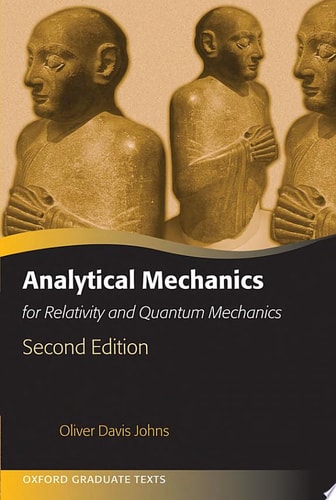
Analytical Mechanics for Relativity and Quantum Mechanics
0
0
As an Amazon Associate and affiliate partner, Menrva Books earns from qualifying purchases. Learn more
Author Description
An innovative and mathematically sound treatment of the foundations of analytical mechanics and the relation of classical mechanics to relativity and quantum mechanics: Part I is an introduction to analytical mechanics, suitable for a graduate or advanced undergraduate course. Part II presents material designed principally for graduate students. The appendices in Part III summarize the mathematical methods used in the text.The book integrates relativity into the teaching of classical mechanics. Part II introduces special relativity and covariant mechanics. It develops extended Lagrangian and Hamiltonian methods that treat time as a transformable coordinate rather than the fixed parameter of Newtonian physics, including an extended definition of canonical transformation that both simplifies the theory and no longer excludes the Lorentz transformation.The book assists students who study classical mechanics as a preparation for quantum mechanics. Analytical mechanics is presented using methods - such as linear vector operators and dyadics - that familiarize the student with similar operator techniques in quantum theory and the dyadic Dirac notation. Comparisons to quantum mechanics appear throughout the text. For example, the chapter on Hamilton-Jacobi theory includes discussions of the closely related Bohm hidden variable model and Feynman path integral method. The chapter on angle-action variables concludes with a section on the old quantum theory.Several of the fundamental problems in physics - the development of quantum information technology, and the problem of quantizing the gravitational field, to name two - require a rethinking of the quantum-classical connection. Graduate students preparing for research careers will find a graduate mechanics course based on this book to be an essential bridge between their undergraduate training and advanced study in analytical mechanics, relativity, and quantum mechanics.New to the Second Edition:Part I contains new chapters
Menrva's Summary
THE THESIS
This text investigates how the foundations of analytical mechanics can be reformulated to create a more cohesive bridge between classical physics, special relativity, and quantum mechanics. Oliver Davis Johns, a physicist with extensive experience in graduate-level instruction, utilizes a rigorous mathematical framework to re-examine Lagrangian and Hamiltonian mechanics. By treating time as a transformable coordinate and employing operator techniques, the author argues that students can better prepare for the conceptual demands of modern quantum theory and relativistic physics.
THE SCOPE MAP
What You Will Find
- Extended Lagrangian and Hamiltonian methods incorporating time as a coordinate
- Mathematical techniques including linear vector operators and dyadics
- Comparative analysis of Hamilton-Jacobi theory, Bohmian mechanics, and Feynman path integrals
- Covariant mechanics and the integration of Lorentz transformations
Scope Limits
- The text assumes a strong background in undergraduate physics and calculus
- It does not provide a comprehensive history of physics, focusing instead on formal mathematical structure
THE AUTHORITY PERSPECTIVE
Physics educators and graduate students frequently cite this text for its unique pedagogical approach to integrating relativity into classical mechanics. Experts highlight the book as a rigorous resource for students transitioning from standard undergraduate mechanics to advanced research in quantum and relativistic fields.
Page Count:
656
Publication Date:
2011-07-14
Publisher:
Oxford University Press
ISBN-10:
0191001627
ISBN-13:
9780191001628
Relativity
Classical Mechanics
Theoretical Physics
Physics
Academic Textbooks
Community Tags
Other Editions(3)
Similar Books


Reader Comments
Share Your Thoughts
No comments yet. Be the first to share your thoughts!