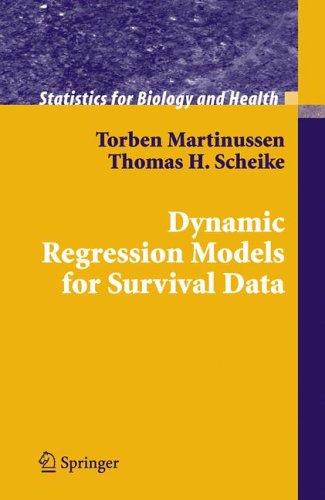
Dynamic Regression Models for Survival Data
0
0
As an Amazon Associate and affiliate partner, Menrva Books earns from qualifying purchases. Learn more
Author Description
In survival analysis there has long been a need for models that goes beyond the Cox model as the proportional hazards assumption often fails in practice. This book studies and applies modern flexible regression models for survival data with a special focus on extensions of the Cox model and alternative models with the specific aim of describing time-varying effects of explanatory variables. One model that receives special attention is Aalen’s additive hazards model that is particularly well suited for dealing with time-varying effects. The book covers the use of residuals and resampling techniques to assess the fit of the models and also points out how the suggested models can be utilised for clustered survival data. The authors demonstrate the practically important aspect of how to do hypothesis testing of time-varying effects making backwards model selection strategies possible for the flexible models considered. The use of the suggested models and methods is illustrated on real data examples. The methods are available in the R-package timereg developed by the authors, which is applied throughout the book with worked examples for the data sets. This gives the reader a unique chance of obtaining hands-on experience. This book is well suited for statistical consultants as well as for those who would like to see more about the theoretical justification of the suggested procedures. It can be used as a textbook for a graduate/master course in survival analysis, and students will appreciate the exercises included after each chapter. The applied side of the book with many worked examples accompanied with R-code shows in detail how one can analyse real data and at the same time gives a deeper understanding of the underlying theory. Torben Martinussen is at the Department of Natural Sciences at the Royal Veterinary and Agricultural University. He has a Ph.D. from University of Copenhagen and is associate editor of the Scandinavian Journal of Statistics. Thomas Scheike is
Menrva's Summary
THE THESIS
This book addresses the limitations of traditional survival analysis models by introducing and applying modern, flexible regression techniques. It focuses on extensions of the Cox model and alternative approaches designed to capture time-varying effects of explanatory variables, with a particular emphasis on Aalen's additive hazards model. The work also details methods for assessing model fit using residuals and resampling, and explores applications for clustered survival data and hypothesis testing of time-varying effects to enable backward model selection strategies.
THE SCOPE MAP
- Exploration of modern flexible regression models for survival data beyond the Cox model.
- Detailed study and application of Aalen's additive hazards model for time-varying effects.
- Methods for assessing model fit using residuals and resampling techniques.
- Utilization of suggested models for clustered survival data.
- Demonstration of hypothesis testing for time-varying effects to enable backward model selection.
- Practical application through real data examples.
- Use of the R-package timereg with worked examples for hands-on experience.
- Theoretical justification for the suggested procedures.
THE AUTHORITY PERSPECTIVE
This book is designed for statistical consultants and researchers seeking advanced methods in survival analysis, offering a theoretical grounding alongside practical application. It is also suitable as a textbook for graduate or master's courses in survival analysis, with exercises provided at the end of each chapter. The inclusion of R-code and worked examples allows readers to gain practical experience and a deeper understanding of the underlying theory.
Page Count:
470
Publication Date:
2006-01-01
ISBN-10:
0387202749
ISBN-13:
9780387202747
Science
Non-Fiction
Regression analysis
Statistics
Data Analysis
Community Tags
Similar Books