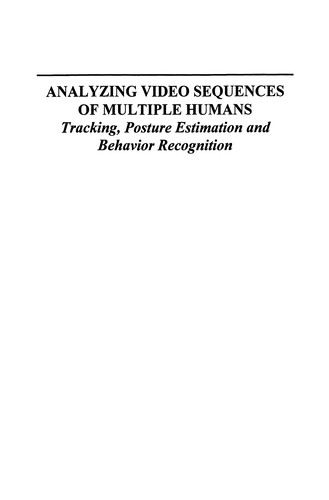
Analyzing Video Sequences of Multiple Humans
0
0
As an Amazon Associate and affiliate partner, Menrva Books earns from qualifying purchases. Learn more
Author Description
Analyzing Video Sequences of Multiple Humans: Tracking, Posture Estimation and Behavior Recognition describes some computer vision-based methods that analyze video sequences of humans. More specifically, methods for tracking multiple humans in a scene, estimating postures of a human body in 3D in real-time, and recognizing a person's behavior (gestures or activities) are discussed. For the tracking algorithm, the authors developed a non-synchronous method that tracks multiple persons by exploiting a Kalman filter that is applied to multiple video sequences. For estimating postures, an algorithm is presented that locates the significant points which determine postures of a human body, in 3D in real-time. Human activities are recognized from a video sequence by the HMM (Hidden Markov Models)-based method that the authors pioneered. The effectiveness of the three methods is shown by experimental results.
Menrva's Summary
THE THESIS
This book explores advanced computer vision techniques for analyzing the complex dynamics of multiple humans within video sequences. It details methods for robustly tracking individuals, estimating their three-dimensional postures in real-time, and recognizing their behaviors, including gestures and activities. The authors present a novel non-synchronous tracking algorithm utilizing a Kalman filter across multiple video feeds, an algorithm for real-time 3D posture estimation by locating key body points, and a pioneering Hidden Markov Model-based approach for activity recognition. Experimental results are provided to demonstrate the efficacy of these developed methods.
THE SCOPE MAP
- Methods for tracking multiple humans in a scene.
- Real-time estimation of human body postures in 3D.
- Recognition of human gestures and activities.
- A non-synchronous tracking algorithm exploiting Kalman filters for multiple video sequences.
- An algorithm for locating significant points to determine 3D human body postures.
- A Hidden Markov Model (HMM)-based method for human activity recognition.
- Experimental results demonstrating the effectiveness of the presented methods.
THE AUTHORITY PERSPECTIVE
The book presents a focused collection of computer vision techniques specifically designed for the analysis of multiple human subjects in video. The methodologies discussed, including Kalman filter-based tracking, real-time 3D posture estimation, and HMM-based behavior recognition, represent significant contributions to the field at the time of its publication. The inclusion of experimental results lends empirical support to the effectiveness of the proposed algorithms. This work is likely to be of interest to researchers and practitioners in computer vision, robotics, and human-computer interaction seeking to understand and interpret complex human actions in visual data.
Page Count:
160
Publication Date:
2002-01-01
ISBN-10:
1461510031
ISBN-13:
9781461510031
Non-Fiction
Science
Robotics
Computer Vision
Community Tags
Similar Books