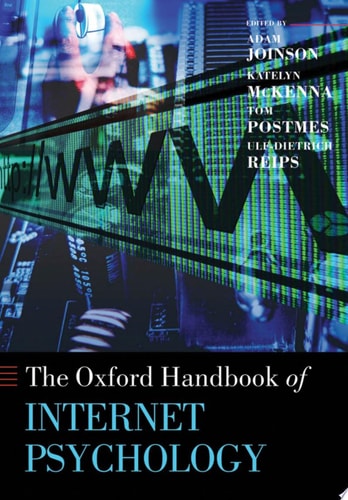
Oxford Handbook of Internet Psychology
0
0
As an Amazon Associate and affiliate partner, Menrva Books earns from qualifying purchases. Learn more
Author Description
Over one billion people use the Internet globally. Psychologists are beginning to understand what people do online, and the impact being online has on behaviour. It's making us re-think many of our existing assumptions about what it means to be a social being. For instance, if we can talk, flirt, meet people and fall in love online, this challenges many of psychology's theories that intimacy or understanding requires physical co-presence. "The Oxford Handbook of Internet Psychology" brings together many of the leading researchers in what can be termed 'Internet Psychology'. Though a very new area of research, it is growing at a phenomenal pace. In addition to well-studied areas of investigation, such as social identity theory, computer-mediated communication and virtual communities, the volume also includes chapters on topics as diverse as deception and misrepresentation, attitude change and persuasion online, Internet addiction, online relationships, privacy and trust, health and leisure use of the Internet, and the nature of interactivity. With over 30 chapters written by experts in the field, the range and depth of coverage is unequalled, and serves to define this emerging area of research. Uniquely, this content is supported by an entire section covering the use of the Internet as a research tool, including qualitative and quantitative methods, online survey design, personality testing, ethics, and technological and design issues. While it is likely to be a popular research resource to be 'dipped into', as a whole volume it is coherent and compelling enough to act as a single text book. "The Oxford Handbook of Internet Psychology" is the definitive text on this burgeoning field. It will be an essential resource for anyone interested in the psychological aspects of Internet use, or planning to conduct research using the 'net'.
Menrva's Summary
THE THESIS
This volume investigates the psychological impact of digital environments on human behavior and social interaction. Edited by Adam Joinson, Tom Postmes, and Ulf-Dietrich Reips, the text synthesizes contributions from leading researchers to establish a formal framework for the emerging field of Internet Psychology. It challenges traditional psychological theories regarding physical co-presence and intimacy by examining how digital mediation alters fundamental social processes.
THE SCOPE MAP
What You Will Find
- Analysis of social identity, computer-mediated communication, and virtual communities
- Investigations into online deception, persuasion, and Internet addiction
- Methodological guidance on online survey design, ethics, and personality testing
- Exploration of health, leisure, and privacy in digital spaces
Scope Limits
- Does not cover the technical engineering or hardware infrastructure of the Internet
- Excludes historical analysis of pre-digital communication technologies
THE AUTHORITY PERSPECTIVE
Experts identify this volume as a foundational text that successfully defines the parameters of Internet Psychology. Readers frequently note the academic density of the prose, which serves as a comprehensive resource for both researchers and students in the field.
Page Count:
517
Publication Date:
2009-01-01
Publisher:
OUP Oxford
ISBN-10:
0191008087
ISBN-13:
9780191008085
Psychology
Research Methods
Community Tags
Similar Books