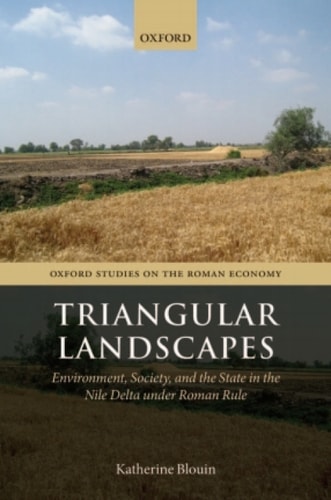
Triangular Landscapes: Environment, Society, and the State in the Nile Delta under Roman Rule
0
0
As an Amazon Associate and affiliate partner, Menrva Books earns from qualifying purchases. Learn more
Author Description
Between the Roman annexation of Egypt and the Arab period, the Nile Delta went from consisting of seven branches to two, namely the current Rosetta and Damietta branches. For historians, this may look like a slow process, but on a geomorphological scale, it is a rather fast one. How did it happen? How did human action contribute to the phenomenon? Why did it start around the Roman period? And how did it impact on ancient Deltaic communities? This volume reflects on these questions by focusing on a district of the north-eastern Delta called the Mendesian Nome. The Mendesian Nome is one of the very few Deltaic zones documented by a significant number of papyri. To date, this documentation has never been subject to a comprehensive study. Yet it provides us with a wealth of information on the region's landscape, administrative geography, and agrarian economy. Starting from these papyri and from all available evidence, this volume investigates the complex networks of relationships between Mendesian environments, socio-economic dynamics, and agro-fiscal policies. Ultimately, it poses the question of the 'otherness' of the Nile Delta, within Egypt and, more broadly, the Roman Empire. Section I sets the broader hydrological, documentary, and historical contexts from which the Roman-period Mendesian evidence stem. Section II is dedicated to the reconstruction of the Mendesian landscape, while section III examines the strategies of diversification and the modes of valorization of marginal land attested in the nome. Finally, section IV analyses the socio-environmental crisis that affected the nome in the second half of the second century AD.
Menrva's Summary
THE THESIS
How did the environmental transformation of the Nile Delta during the Roman period intersect with human agency, administrative policy, and the socio-economic stability of local communities? Katherine Blouin, a specialist in the history of Roman Egypt, utilizes a synthesis of papyrological evidence and geomorphological data to examine the Mendesian Nome. Her argument posits that the rapid hydrological shifts in the Delta were not merely natural phenomena but were deeply influenced by the interplay between Roman agro-fiscal policies and the adaptive strategies of local inhabitants.
THE SCOPE MAP
What You Will Find
- Analysis of the Mendesian Nome through previously underutilized papyrological archives.
- Reconstruction of the hydrological and geomorphological evolution of the Nile Delta branches.
- Examination of land management strategies and the valorization of marginal territories.
- Investigation into the socio-environmental crisis occurring in the second century AD.
Scope Limits
- The study is geographically restricted to the Mendesian Nome rather than the entirety of the Nile Delta.
- The analysis focuses primarily on the Roman period, excluding extensive coverage of the subsequent Arab period.
THE AUTHORITY PERSPECTIVE
Experts recognize this work as a significant contribution to the study of the Roman economy, particularly for its integration of environmental science with traditional historical documentation. Readers frequently note the academic density of the prose, which serves as a rigorous resource for scholars of ancient Egyptian administrative and agrarian history.
Page Count:
464
Publication Date:
2014-01-01
Publisher:
OUP Oxford
ISBN-10:
0191002399
ISBN-13:
9780191002397
History
Economics
Egyptology
Roman Empire
Environmental History
Ancient History
Land Use
Archaeology
Egypt - History