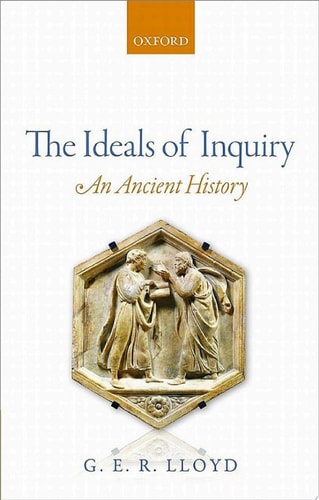
The Ideals of Inquiry: An Ancient History
0
0
As an Amazon Associate and affiliate partner, Menrva Books earns from qualifying purchases. Learn more
Author Description
Long before science as we know it today existed, sophisticated studies of the external world were undertaken, notably in Mesopotamia, India, China, and Greece. G. E. R. Lloyd explores three interrelated issues concerning those investigations. This first issue is methods--how was it thought that they should be pursued? The second is subject-matter--what was assumed about what there is to be investigated? The third issue is aims and value--what were such investigations thought to be good for? Thus how did an ideal of demonstration that would yield incontrovertible conclusions come to arise and what did it owe to the political institutions of the society in which it first developed, namely ancient Greece? Debate has been widely practised and not just in literate societies: Lloyd's second chapter draws up a taxonomy of ancient debates and discusses how the ideals of transparency and accountability were made explicit. Then how did ideas about the need to undertake systematic research come to be formulated and such research practised, and what obstacles did it face? Different equally valid assumptions have been made about what there is to be investigated, reflecting what is here called the multidimensionality of the phenomena, and different ancient investigators entertained different aims for their work, mirroring but sometimes going beyond the current values of their society. Taking stock of all this diversity, the final chapter spells out the implications for our understanding of the history of human reasoning in general, exploring its commonalities and where and why it has manifested and continues to manifest specificities across different populations.
Menrva's Summary
THE THESIS
This work investigates the origins and evolution of inquiry, questioning how ancient civilizations established methods, subject matter, and the perceived value of systematic investigation. G. E. R. Lloyd, a distinguished historian of ancient science, utilizes a comparative framework to examine intellectual traditions across Mesopotamia, India, China, and Greece. He argues that the development of rigorous demonstration and systematic research is deeply intertwined with the political and social structures of the societies in which these practices emerged.
THE SCOPE MAP
What You Will Find
- A comparative analysis of intellectual inquiry across four major ancient civilizations.
- A taxonomy of ancient debate styles and the evolution of transparency and accountability.
- An exploration of the multidimensionality of phenomena and how it influenced research assumptions.
Scope Limits
- The text does not provide a comprehensive history of all scientific discoveries in these regions.
- It does not focus on the technical mechanics of specific ancient technologies or mathematical proofs.
THE AUTHORITY PERSPECTIVE
Scholars frequently cite this work as a significant contribution to the comparative history of human reasoning and intellectual development. Readers often note the academic density of the prose, which requires a foundational understanding of ancient philosophical and political contexts.
Page Count:
176
Publication Date:
2014-01-01
Publisher:
OUP Oxford
ISBN-10:
0191016098
ISBN-13:
9780191016097
Philosophy
History
History & Surveys
Knowledge Theory
Epistemology
Intellectual History
Ancient History
Science History
Community Tags
Similar Books