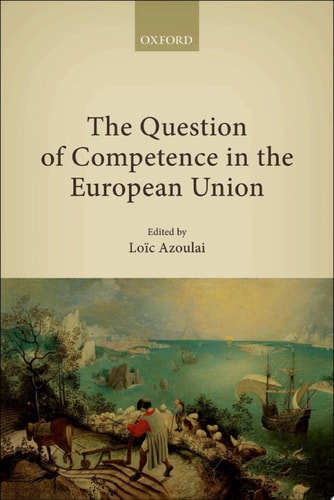
The Question of Competence in the European Union
0
0
As an Amazon Associate and affiliate partner, Menrva Books earns from qualifying purchases. Learn more
Author Description
The classic debate surrounding the prolific role of the European Union in defining spheres of competence and power relationships has long divided scholarly opinion. However, in recent years, the long-standing acquiescence to the broad powers of the Union has given way to the emerging perception of a competence problem in Europe. For a long period it was taken for granted that the European Community could act whenever its action was justified on the basis of the widely interpreted objectives of the Treaties. However this context has since changed. There is a widespread perception of a competence problem in Europe and the overabundance of provisions limiting the Union's competences is one of the most obvious marks left by the Lisbon Treaty. This book discusses the extent to which the parameters of power throughout the Union and its Member States have been recast by the recent implementation of the Lisbon Treaty and doctrines developed by the European Court of Justice. Comprised of contributions from a vast array of leading practitioners and academics in the field of EU Law, this volume assesses the debate surrounding the political identity of the European Union, and further illustrates the relevance of the Federal theory of sharing competences for the development of EU Law. Finally, the question of new potential limits to Union's competence is addressed. If anything, this broad reflection on the notion of competence in the EU law context is a way of opening up the question of the nature and contours of the political identity of the European Union.
Menrva's Summary
THE THESIS
This volume investigates the shifting legal and political boundaries of the European Union's authority in the wake of the Lisbon Treaty. Edited by Loïc Azoulai, the text compiles research from prominent legal scholars and practitioners to analyze how the European Court of Justice and new treaty provisions have redefined the distribution of power between the Union and its Member States. The work argues that the traditional assumption of broad Union competence is being replaced by a more restrictive framework that necessitates a re-evaluation of the EU's political identity.
THE SCOPE MAP
What You Will Find
- Analysis of the impact of the Lisbon Treaty on Union competence.
- Examination of European Court of Justice doctrines regarding power distribution.
- Application of Federal theory to the sharing of competences in EU law.
- Discussion on the political identity and future limitations of the European Union.
Scope Limits
- The text focuses primarily on legal and constitutional frameworks rather than the day-to-day administrative operations of EU institutions.
- It does not provide a comprehensive history of the European Union prior to the implementation of the Lisbon Treaty.
THE AUTHORITY PERSPECTIVE
Experts in the field of European law recognize this volume as a significant contribution to the discourse on constitutional limits within the Union. Readers frequently note the academic density of the prose, making it a resource primarily intended for legal scholars, practitioners, and advanced students of European integration.
Page Count:
309
Publication Date:
2014-01-01
Publisher:
OUP Oxford
ISBN-10:
0191015318
ISBN-13:
9780191015311
International relations
Law
Professional Career & Trade
Constitutional Law
European Union
Community Tags
Other Editions(3)

Similar Books