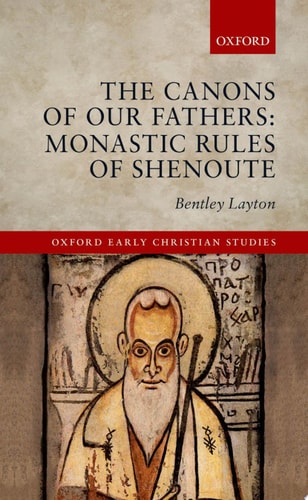
The Canons of Our Fathers: Monastic Rules of Shenoute
0
0
As an Amazon Associate and affiliate partner, Menrva Books earns from qualifying purchases. Learn more
Author Description
This book is the first publication of a very early collection of Christian monastic rules from Roman Egypt. Designed for the so-called White Monastery Federation, a community of monks and nuns who banded together about 360 CE, the rules are quoted by the great monastic leader Shenoute of Atripe in his writings of the fourth and fifth century. These rules provide new and intimate access to the earliest phases of Christian communal (cenobitic) monasticism.In this volume, Bentley Layton presents for the first time the Coptic text of the rules, amounting to five hundred and ninety-five entries, accompanied by a clear and exact English translation. Four preliminary chapters discuss the character of the rules in their historical and social context, and present new evidence for the founding of the monastic federation. From passing remarks in the rules, Layton paints a brilliant picture of monastic daily life and ascetic practice, organized around six general topics: the monastery as a physical plant, the human makeup of the community, the pattern of ascetic observances, the hierarchy of authority, the daily liturgy, and monastic economic life. The Canons of Our Fathers will be a fundamental resource for readers interested in Christian life in late antiquity, ascetic practices, and the history of monasticism in all its forms.
Menrva's Summary
THE THESIS
This volume investigates the foundational structures and daily operational regulations of the White Monastery Federation in Roman Egypt during the fourth and fifth centuries. Bentley Layton, a scholar of Coptic language and history, utilizes the surviving Coptic text of the monastic rules to reconstruct the social and ascetic framework of early cenobitic monasticism. By analyzing these five hundred and ninety-five entries, the author provides a systematic examination of how early Christian communities organized their physical, spiritual, and economic lives.
THE SCOPE MAP
What You Will Find
- The original Coptic text of the monastic rules alongside a modern English translation.
- A historical analysis of the founding of the White Monastery Federation.
- A thematic categorization of monastic life including liturgy, hierarchy, and ascetic practice.
Scope Limits
- The text focuses specifically on the White Monastery Federation and does not provide a comprehensive history of all Egyptian monasticism.
- The analysis is limited to the surviving rules and does not attempt to reconstruct the entirety of Shenoute's broader theological corpus.
THE AUTHORITY PERSPECTIVE
Scholars and historians of late antiquity identify this work as a primary resource for understanding the practical implementation of early Christian asceticism. Readers frequently note the academic density of the prose and the precision of the translation as key features for researchers in the field.
Page Count:
384
Publication Date:
2014-01-01
Publisher:
OUP Oxford
ISBN-10:
0191019224
ISBN-13:
9780191019227
History
Religion
Egypt
Academic
Worship & Devotion
Kindle Store
Coptic Studies
Late Antiquity
Christianity
Monasticism
Kindle eBooks
Church History
Categories
Institutions & Organizations
Coptic Church
Church Leadership
Community Tags
Similar Books