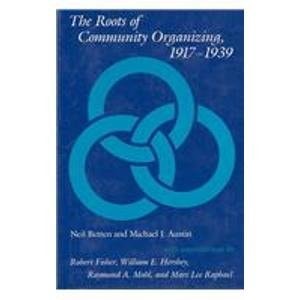
The Roots of Community Organizing, 1917-1939
0
0
As an Amazon Associate and affiliate partner, Menrva Books earns from qualifying purchases. Learn more
Author Description
Today's community organizers and social planners have a tendency to ignore their antecedents and to "reinvent the wheel." "What is found in textbooks today had its origins in the day-to-day, trial-and-error experiences of community organizers in the 1920s and 1930s," state Michael J. Austin and Neil Betten in their Introduction to this pioneering study of community organization. The historical analysis of the intellectual and practical roots of community organizing in the United States begins with urban political organizing in the late nineteenth and early twentieth centuries, the organizing of immigrant communities by the International Institutes beginning in 1910, and the Cincinnati Unit Experiment from 1917 to 1919.The authors and their collaborators focus on historical material that has received relatively little attention within the profession. This includes the "organizing manuals" of Steiner, McClenahan, Hart, Pettit, and Lindeman; the emergence, in the 1920s, of physical planning as practiced by city planners and social survey research as practiced by social planners; and the social action approach to community organizing with special reference to organizing the working class. "There is clearly a dualism in this work," comment Betten and Austin. Not only does the book provide insight into the background of community organizing stemming from various social agencies, but it also explores the activities of people and groups that were organizing communities but did not consider themselves community organizers. These include the socialists involved with the Cincinnati Unit Experiment, political machines, an the Catholic Worker Movement.While the study encompasses a time period from the last years of the nineteenth century to the end of the 1930s, it focuses primarily on the years from 1917 to 1939, when community organizing associated with the social work profession was emerging. The study ends in 1939 with the Lane Report, which was the first effort to identify
Menrva's Summary
THE THESIS
The Roots of Community Organizing, 1917-1939 examines the often-overlooked historical foundations of modern community organizing and social planning in the United States. It argues that contemporary practitioners frequently neglect the foundational work and trial-and-error experiences of early 20th-century organizers. The book traces these roots from late 19th and early 20th-century urban political organizing through immigrant community efforts and the Cincinnati Unit Experiment. It highlights the intellectual and practical developments, including organizing manuals, physical and social planning, and social action approaches, particularly concerning the working class.
THE SCOPE MAP
- Historical analysis of community organizing's intellectual and practical roots in the U.S.
- Focus on organizing manuals by Steiner, McClenahan, Hart, Pettit, and Lindeman
- Emergence of physical planning and social survey research in the 1920s
- Exploration of the social action approach to organizing the working class
- Inclusion of groups that organized communities without self-identifying as organizers (socialists, political machines, Catholic Worker Movement)
- Primary focus on the period 1917-1939, the emergence of community organizing within the social work profession
- Concluding with the 1939 Lane Report, an early attempt at identification and definition
THE AUTHORITY PERSPECTIVE
This study is presented as a pioneering work that aims to fill a gap in the historical understanding of community organizing by focusing on less-examined material. The authors and their collaborators emphasize the value of uncovering the day-to-day, trial-and-error experiences of early organizers. The book's approach is noted for its dualism, exploring both the organized efforts within social agencies and the activities of less formally recognized organizing groups. It seeks to provide insight into the historical context that shaped contemporary practices.
Page Count:
230
Publication Date:
1990-01-01
Publisher:
Temple University Press
ISBN-10:
0877226628
ISBN-13:
9780877226628
Non-Fiction
History
Social Work
Community Development
Community Tags
Similar Books












Reader Comments
Share Your Thoughts
No comments yet. Be the first to share your thoughts!