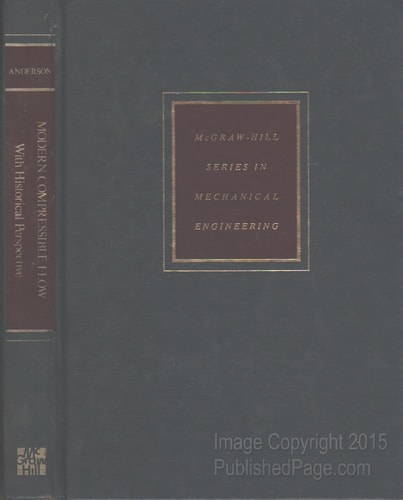
Modern compressible flow: With historical perspective (McGraw-Hill series in mechanical engineering)
0
0
As an Amazon Associate and affiliate partner, Menrva Books earns from qualifying purchases. Learn more
Author Description
Anderson's book provides the most accessible approach to compressible flow for Mechanical and Aerospace Engineering students and professionals. In keeping with previous versions, the 3rd edition uses numerous historical vignettes that show the evolution of the field. New pedagogical features--"Roadmaps" showing the development of a given topic, and "Design Boxes" giving examples of design decisions--will make the 3rd edition even more practical and user-friendly than before. The 3rd edition strikes a careful balance between classical methods of determining compressible flow, and modern numerical and computer techniques (such as CFD) now used widely in industry & research. A new Book Website will contain all problem solutions for instructors.
Menrva's Summary
THE THESIS
This text investigates the fundamental principles of compressible flow while contextualizing the development of the field through a historical lens. John D. Anderson Jr., a distinguished professor and historian of aerospace engineering, utilizes his extensive academic background to bridge the gap between classical analytical methods and contemporary computational fluid dynamics (CFD). The book presents a structured framework designed to guide students and professionals through the complex physical behaviors of high-speed gas dynamics.
THE SCOPE MAP
What You Will Find
- Comprehensive coverage of compressible flow equations and shock wave theory
- Pedagogical 'Roadmaps' for conceptual navigation of complex topics
- 'Design Boxes' illustrating practical engineering decision-making processes
- Integration of modern numerical techniques alongside classical analytical solutions
Scope Limits
- The text focuses primarily on mechanical and aerospace engineering applications
- It does not provide an exhaustive manual for specific commercial CFD software packages
THE AUTHORITY PERSPECTIVE
Experts and educators consistently identify this work as a foundational text for undergraduate and graduate-level aerospace engineering curricula. Readers frequently note the clarity of the prose and the effectiveness of the historical vignettes in grounding abstract mathematical concepts in real-world engineering practice.
Page Count:
466
Publication Date:
1982-01-01
Publisher:
McGraw-Hill Series in Mechanical Engineering
ISBN-10:
0070016542
ISBN-13:
9780070016545
textbook
Fluid dynamics
Astronomy
Mechanical engineering
Physics
Aerospace Engineering
Mathematics
Engineering
SCIENCE Astronomy
Mechanics
Community Tags
Similar Books