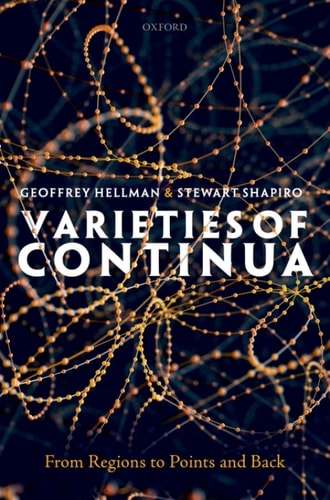
Varieties of Continua: From Regions to Points and Back
0
0
As an Amazon Associate and affiliate partner, Menrva Books earns from qualifying purchases. Learn more
Author Description
Varieties of Continua explores the development of the idea of the continuous. Hellman and Shapiro begin with two historical episodes. The first is the remarkably rapid transition in the course of the nineteenth century from the ancient Aristotelian view, that a true continuum cannot be composed of points, to the now standard, point-based frameworks for analysis and geometry found in modern mainstream mathematics (stemming from the work of Bolzano, Cauchy, Weierstrass, Dedekind, Cantor, et al.). The second is the mid-tolate-twentieth century revival of pre-limit methods in analysis and geometry using infinitesimals including non-standard analysis (due to Abraham Robinson), and the more radical smooth infinitesimal analysis that uses intuitionistic logic. Hellman and Shapiro present a systematic comparison of these and related alternatives (including constructivist and predicative conceptions), weighing various trade-offs, helping articulate a modern pluralist perspective, and articulate a modern pluralist perspective on continuity. The main creative work of the book is the development of rigorous regions-based theories of classical continua, including Euclidean and non-Euclidean geometries, that are mathematically equivalent (inter-reducible) to the currently standard, point-based accounts in mainstream mathematics.
Menrva's Summary
THE THESIS
This book investigates the conceptual and mathematical foundations of the continuum, specifically questioning whether a continuum must be composed of points or if alternative, region-based frameworks are viable. The authors, Geoffrey Hellman and Stewart Shapiro, utilize a combination of historical analysis and formal mathematical construction to evaluate various conceptions of continuity. By comparing standard point-based analysis with infinitesimal and constructivist alternatives, they argue for a pluralist perspective that accommodates multiple rigorous interpretations of the continuous.
THE SCOPE MAP
What You Will Find
- Historical transition from Aristotelian views to nineteenth-century point-based analysis.
- Examination of non-standard analysis and smooth infinitesimal analysis.
- Development of rigorous regions-based theories for Euclidean and non-Euclidean geometries.
- Comparative analysis of constructivist and predicative conceptions.
Scope Limits
- The text does not provide an exhaustive history of all mathematical thought regarding space.
- It focuses primarily on formal mathematical and philosophical frameworks rather than pedagogical applications.
THE AUTHORITY PERSPECTIVE
Experts recognize this work as a significant contribution to the philosophy of mathematics, particularly for its formalization of region-based theories. Readers frequently note the technical density of the prose, which requires a strong background in mathematical logic and analysis to fully appreciate the authors' arguments.
Page Count:
224
Publication Date:
2018-01-01
Publisher:
OUP Oxford
ISBN-10:
0191021350
ISBN-13:
9780191021350
Philosophy
Geometry
Philosophy of
Logic
Logic & Critical Reasoning
Mathematics
Analysis
Continuity
Community Tags
Similar Books