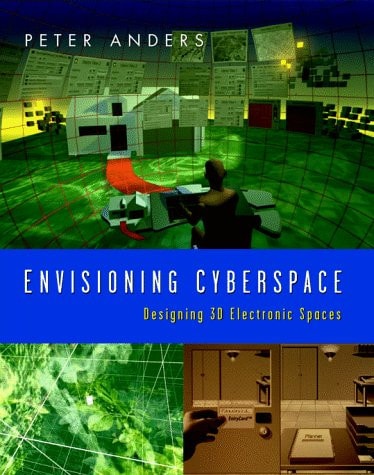
Envisioning Cyberspace: Designing 3D Electronic Spaces
0
0
As an Amazon Associate and affiliate partner, Menrva Books earns from qualifying purchases. Learn more
Author Description
Free of the constraints of physical form and limited only by imagination, new environments spring to life daily in a fantastic realm called cyberspace. The creators of this new virtual world may be programmers, designers, architects, even children. In this invigorating exploration of the juncture between cyberspace and the physical world, architect Peter Anders brings together leading-edge cyberspace art and architecture... inspiring new techniques and technologies... unexpected unions of reality and virtuality... and visions of challenges and opportunities as yet unexplored. More than an invitation to tour fantastic realms and examine powerful tools, this book is a hard-eyed look at cyberspace's impact on physical, cultural, and social reality, and the human-centered principles of its design. This is a book that will set designers and architects thinking—and a work of importance to anyone fascinated with the fast-closing space between the real and the virtual.
Menrva's Summary
THE THESIS
How can the principles of physical architecture be applied to the design of virtual, three-dimensional electronic spaces? Architect Peter Anders investigates the intersection of physical design and digital environments, arguing that cyberspace should be treated as a legitimate architectural space rather than merely a data interface. Drawing on his professional background in architecture, Anders synthesizes technical design concepts with social and cultural theory to propose a framework for creating human-centered virtual worlds.
THE SCOPE MAP
What You Will Find
- Theoretical frameworks for spatial design in digital environments
- Analysis of the relationship between physical reality and virtuality
- Exploration of human-centered design principles for cyberspace
Scope Limits
- Does not provide specific programming tutorials or software-specific coding instructions
- Does not cover the history of the internet or networking protocols in depth
THE AUTHORITY PERSPECTIVE
Experts and designers frequently cite this work as a foundational text for understanding the spatialization of digital information. Readers often note the academic density of the prose, which bridges the gap between traditional architectural theory and emerging digital design practices.
Page Count:
228
Publication Date:
1998-10-30
Publisher:
McGraw-Hill Professional
ISBN-10:
0070016321
ISBN-13:
9780070016323
Architecture
Digital Media
Strategy Guides
Human Interaction
Computers & Technology
Social Media
Technology
3D Graphics
Drafting & Presentation
Graphics & Multimedia
New Used & Rental Textbooks
Desktop Publishing
Software Engineering
Programming
Design
Science & Math
Graphics & Design
Mathematics
Cyberculture
Architecture
Computer Science
Community Tags
Similar Books