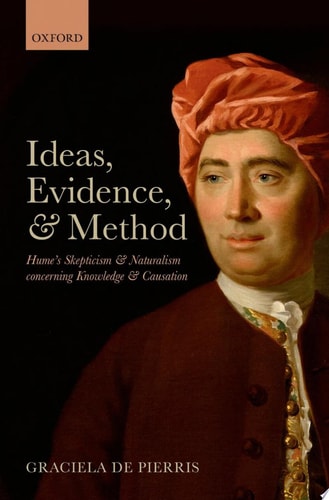
Ideas, Evidence, and Method: Hume's Skepticism and Naturalism Concerning Knowledge and Causation
0
0
As an Amazon Associate and affiliate partner, Menrva Books earns from qualifying purchases. Learn more
Author Description
Graciela De Pierris Presents A Novel Interpretation Of The Relationship Between Skepticism And Naturalism In Hume's Epistemology, And A New Appraisal Of Hume's Place Within Early Modern Thought. Whereas A Dominant Trend In Recent Hume Scholarship Maintains That There Are No Skeptical Arguments Concerning Causation And Induction In Book I, Part Iii Of The Treatise, Graciela De Pierris Presents A Detailed Reading Of The Skeptical Argument She Finds There And How This Argument Initiates A Train Of Skeptical Reasoning That Begins In Part Iii And Culminates In Part Iv. This Reasoning Is Framed By Hume's Version Of The Modern Theory Of Ideas Developed By Descartes And Locke. The Skeptical Implications Of This Theory, However, Do Not Arise, As In Traditional Interpretations Of Hume's Skepticism, From The 'veil Of Perception.' They Arise From Hume's Elaboration Of A Presentational-phenomenological Model Of Ultimate Evidence, According To Which There Is Always A Justificatory Gap Between What Is Or Has Been Immediately Presented To The Mind And Any Ideas That Go Beyond It. This Happens, Paradigmatically, In The Causal-inductive Inference, And, As De Pierris Argues, In Demonstrative Inference As Well. Yet, In Spite Of His Firm Commitment To Radical Skepticism, Hume Also Accepts The Naturalistic Standpoint Of Science And Common Life, And He Does So, On The Novel Interpretation Presented Here, Because Of An Equally Firm Commitment To Newtonian Science In General And The Newtonian Inductive Method In Particular. Hume Defends The Newtonian Method (against The Mechanical Philosophy) While Simultaneously Rejecting All Attempts (including Those Of The Newtonians) To Find A Place For The Supernatural Within Our Understanding Of Nature.
Menrva's Summary
THE THESIS
This work investigates the complex interplay between skepticism and naturalism within David Hume's epistemology, specifically addressing how his commitment to Newtonian methodology reconciles with his radical skeptical conclusions. Graciela De Pierris, a scholar of early modern philosophy, utilizes a close reading of Hume's A Treatise of Human Nature to challenge contemporary interpretations that minimize the role of skepticism regarding causation and induction. She argues that Hume's skepticism emerges not from a 'veil of perception' but from a presentational-phenomenological model of evidence that creates a justificatory gap between immediate experience and inferred ideas.
THE SCOPE MAP
What You Will Find
- A detailed analysis of Book I, Part III and Part IV of Hume's Treatise.
- An examination of the modern theory of ideas as developed by Descartes and Locke.
- A reconstruction of Hume's commitment to the Newtonian inductive method.
Scope Limits
- The text does not provide a general biography of Hume.
- The analysis is restricted to Hume's epistemological and causal arguments rather than his moral or political philosophy.
THE AUTHORITY PERSPECTIVE
Scholars recognize this text as a significant contribution to Humean studies, particularly for its rigorous challenge to the 'naturalistic' reading of Hume that ignores his skeptical arguments. Readers frequently note the academic density of the prose, which requires a strong background in early modern philosophy to fully grasp the nuances of the author's argument.
Page Count:
336
Publication Date:
2015-01-01
Publisher:
Oxford University Press, Incorporated
ISBN-10:
0191026166
ISBN-13:
9780191026164
Philosophy
Knowledge Theory
Epistemology
Skepticism
Early Modern
David Hume
Philosophy history
Criticism history
Community Tags
Other Editions(2)
Similar Books

Reader Comments
Share Your Thoughts
No comments yet. Be the first to share your thoughts!