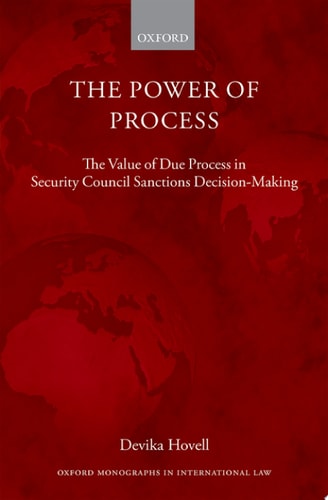
The Power of Process
0
0
As an Amazon Associate and affiliate partner, Menrva Books earns from qualifying purchases. Learn more
Author Description
The Un Security Council's Transition To 'targeted Sanctions' In The 1990s Marked A Revolutionary Shift In The Locus Of The Council's Decision-making From States To Individuals. The Establishment Of The Targeted Sanctions Regime, Should Be Regarded As More Than A Shift In Policy And Invites Attention To An Emerging Tier Of International Governance. This Book Examines The Need To Develop A Due Process Framework Having Regard To The Uniquely Political And Crisis-based Context In Which The Security Council Operates. Drawing On Anglo-american Jurisprudence, This Book Develops Procedural Principles For The International Institutional Context Using A Value-based Approach As An Alternative To The Formalistic Approach Taken In The Literature To Date. In Doing So, It Is Recognized That Due Process Is More Than A Set Of Discrete Legal Standards, But Is A Touchstone For The Way The International Legal Order Conceives Of Far Larger Questions About Community, Law And Values.
Menrva's Summary
THE THESIS
This book investigates the necessity of establishing a due process framework within the United Nations Security Council to address the legal implications of targeted sanctions against individuals. Author Devika Hovell, an expert in international law, utilizes a value-based approach to critique existing formalistic interpretations. By synthesizing Anglo-American jurisprudence with the unique political realities of the Security Council, the work argues that procedural standards are essential for the legitimacy of the international legal order.
THE SCOPE MAP
What You Will Find
- Analysis of the transition from state-based to individual-targeted sanctions in the 1990s.
- A proposed value-based framework for international institutional due process.
- Comparative study of Anglo-American legal principles applied to international governance.
Scope Limits
- The text does not provide a comprehensive history of all UN sanctions regimes.
- It does not offer a practical manual for legal practitioners but focuses on theoretical and procedural development.
THE AUTHORITY PERSPECTIVE
Legal scholars and international relations experts recognize this work as a significant contribution to the discourse on institutional accountability. Readers frequently note the academic density of the prose, which is intended for advanced students and practitioners of international law.
Page Count:
224
Publication Date:
2016-01-01
Publisher:
Oxford University Press
ISBN-10:
0191027448
ISBN-13:
9780191027444
Human rights
Governance
International Law
Jurisprudence
United Nations
Community Tags
Similar Books