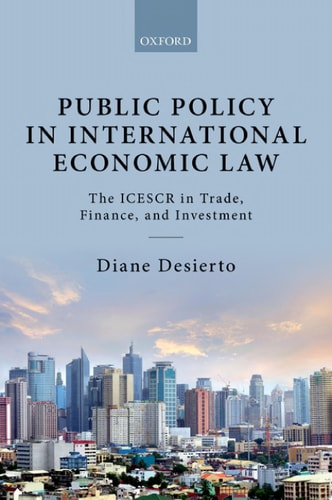
Public Policy in International Economic Law
0
0
As an Amazon Associate and affiliate partner, Menrva Books earns from qualifying purchases. Learn more
Author Description
States Reject Inequality When They Choose To Ratify The International Covenant On Economic, Social And Cultural Rights (icescr), But To Date The Icescr Has Not Yet Figured Prominently In The Policy Calculus Behind States' International Economic Decisions. This Book Responds To The Modern Challenge Of Operationalizing The Icescr, Particularly In The Context Of States' Decisions Within International Trade, Finance, And Investment. Differentiating Between Public Policy Mechanisms And Institutional Functional Mandates In The International Trade, Finance, And Investment Systems, This Book Shows Legal And Policy Gateways For States To Feasibly Translate Their Fundamental Duties To Respect, Protect, And Fulfil Economic, Social And Cultural Rights Into Their Trade, Finance, And Investment Commitments, Agreements, And Contracts. It Approaches The Problem Of Harmonizing Social Protection Objectives Under The Icescr With A State's International Economic Treaty Obligations, From The Designing And Interpreting International Treaty Texts, Up To The Institutional Monitoring And Empirical Analysis Of Icescr Compliance. In Examining Public Policy Options, The Book Takes Into Account Around Five Decades Of States' Implementation Of Social Protection Commitments Under The Icescr; Its Normative Evolution Through The Un Committee On Economic, Social And Cultural Rights, And The Committee's Expanded Fact-finding And Adjudicative Competences Under The Optional Protocol To The Icescr; As Well As The Critical, Dialectical, And Deliberative Roles Of Diverse Functional Interpretive Communities Within International Trade, Finance, And Investment Law. Ultimately, The Book Shoes How States' Icescr Commitments Operate As The Normative Foundation Of Their Trade, Finance, And Investment Decisions.
Menrva's Summary
THE THESIS
This book investigates how states can effectively integrate their obligations under the International Covenant on Economic, Social and Cultural Rights (ICESCR) into their international trade, finance, and investment policies. Diane Desierto, an expert in international law and human rights, utilizes five decades of state implementation data and normative evolution from the UN Committee on Economic, Social and Cultural Rights to construct her argument. She proposes a framework that distinguishes between public policy mechanisms and institutional mandates, providing a roadmap for states to align their economic treaty commitments with their fundamental human rights duties.
THE SCOPE MAP
What You Will Find
- Analysis of the normative evolution of the ICESCR through UN committee interpretations.
- Methodologies for designing and interpreting international treaty texts to include social protection objectives.
- Examination of the Optional Protocol to the ICESCR and its impact on state compliance.
- Discussion of the roles of diverse functional interpretive communities in international economic law.
Scope Limits
- The text focuses primarily on the intersection of ICESCR obligations and international economic law, rather than providing a general overview of human rights law.
- It does not cover domestic economic policy implementation outside the context of international treaty obligations.
THE AUTHORITY PERSPECTIVE
Legal scholars and practitioners identify this work as a significant contribution to the harmonization of human rights and international economic law. Readers frequently note the academic density of the prose, which serves as a rigorous resource for those navigating the complexities of international treaty compliance.
Page Count:
432
Publication Date:
2015-01-01
Publisher:
Oup Oxford
ISBN-10:
0191026476
ISBN-13:
9780191026478
Economics
International Trade
International Law
Finance
Investment Law
Human rights
Public Policy
Community Tags
Similar Books