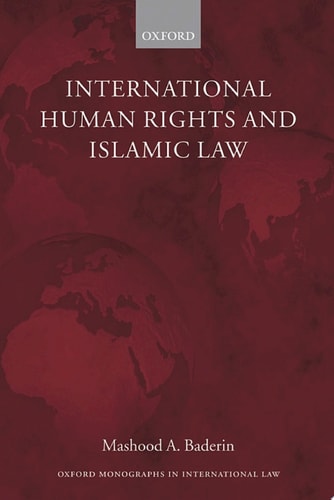
International Human Rights and Islamic Law
0
0
As an Amazon Associate and affiliate partner, Menrva Books earns from qualifying purchases. Learn more
Author Description
This volume examines the important question of whether or not international human rights and Islamic law are compatible. It asks whether Muslim States can comply with international human rights law whilst adhering to Islamic law. The traditional arguments on this subject are examined and responded to from both international human rights and Islamic legal perspectives. The volume engages international human rights law in theoretical dialogue with Islamic law, facilitating an evaluation of the human rights policy of modern Muslim States. International Human Rights and Islamic Law formulates a synthesis between these two extremes, and argues that although there are differences of scope and application, there is no fundamental incompatibility between these two bodies of law. Baderin argues that their differences could be better addressed if the concept of human rights were positively established from within the themes of Islamic law, rather than by imposing it upon Islamic law as an alien concept. Each article of the International Covenant on Civil and Political Rights, and the International Covenant on Economic, Social and Cultural Rights, as well as relevant articles of the Convention on the Elimination of All Forms of Discrimination against Women are analysed in the light of Islamic law. The volume concludes that it is possible to harmonise the differences between international human rights law and Islamic law through the adoption of the 'margin of appreciation' doctrine by international human rights treaty bodies and the utilization of the Islamic law doctrines of 'maqâsid al-sharî'ah' (the overall objective of Sharî'ah) and 'maslahah' (welfare) by Muslim States in their interpretation and application of Islamic law respectively. Baderin asserts that Islamic law can serve as an important vehicle for the guarantee and enforcement of international human rights law in the Muslim world, and the volume concludes with recommendations to that effect.
Menrva's Summary
THE THESIS
This volume investigates the compatibility between international human rights standards and the principles of Islamic law within the context of modern Muslim states. Mashood A. Baderin, an expert in international law and human rights, utilizes a comparative legal framework to analyze the potential for harmonization. By examining the theoretical and practical intersections of these two legal systems, the author argues that they are not fundamentally incompatible and proposes a methodology for their integration.
THE SCOPE MAP
What You Will Find
- Comparative analysis of the International Covenant on Civil and Political Rights and the International Covenant on Economic, Social and Cultural Rights.
- Application of the 'margin of appreciation' doctrine to international treaty bodies.
- Utilization of Islamic legal doctrines including 'maqâsid al-sharî'ah' and 'maslahah'.
- Evaluation of human rights policy implementation in modern Muslim states.
Scope Limits
- The text does not provide a comprehensive history of Islamic jurisprudence outside of its relation to modern human rights frameworks.
- It does not offer a political analysis of specific regimes beyond their legal adherence to international treaties.
THE AUTHORITY PERSPECTIVE
Legal scholars and practitioners frequently cite this work as a foundational text for understanding the intersection of international human rights and Islamic legal theory. Experts highlight the author's balanced approach and the academic rigor applied to the reconciliation of these two distinct legal systems.
Page Count:
293
Publication Date:
2003-01-01
Publisher:
OUP Oxford
ISBN-10:
0191021822
ISBN-13:
9780191021824
International Law
Professional Career & Trade
Religion and Law
Islamic Law
Law
Human rights
Community Tags
Other Editions(2)
Similar Books






Reader Comments
Share Your Thoughts
No comments yet. Be the first to share your thoughts!