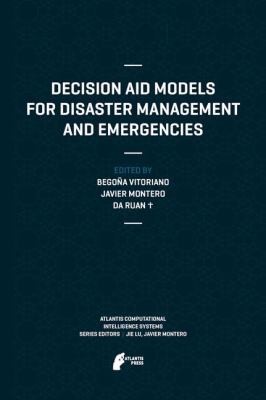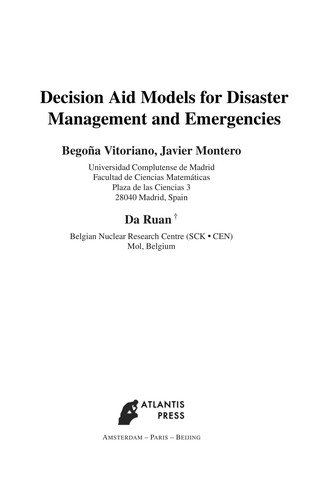
Decision Aid Models for Disaster Management and Emergencies
0
0
As an Amazon Associate and affiliate partner, Menrva Books earns from qualifying purchases. Learn more
Author Description
Disaster management is a process or strategy that is implemented when any type of catastrophic event takes place. The process may be initiated when anything threatens to disrupt normal operations or puts the lives of human beings at risk. Governments on all levels as well as many businesses create some sort of disaster plan that make it possible to overcome the catastrophe and return to normal function as quickly as possible. Response to natural disasters (e.g., floods, earthquakes) or technological disaster (e.g., nuclear, chemical) is an extreme complex process that involves severe time pressure, various uncertainties, high non-linearity and many stakeholders. Disaster management often requires several autonomous agencies to collaboratively mitigate, prepare, respond, and recover from heterogeneous and dynamic sets of hazards to society. Almost all disasters involve high degrees of novelty to deal with most unexpected various uncertainties and dynamic time pressures. Existing studies and approaches within disaster management have mainly been focused on some specific type of disasters with certain agency oriented. There is a lack of a general framework to deal with similarities and synergies among different disasters by taking their specific features into account. This book provides with various decisions analysis theories and support tools in complex systems in general and in disaster management in particular. The book is also generated during a long-term preparation of a European project proposal among most leading experts in the areas related to the book title. Chapters are evaluated based on quality and originality in theory and methodology, application oriented, relevance to the title of the book.
Menrva's Summary
THE THESIS
This book investigates the development and application of decision aid models for complex disaster management scenarios. It addresses the inherent challenges of disaster response, including time pressure, uncertainty, and the coordination of multiple agencies, by providing a framework that considers similarities and synergies across different types of disasters. The work draws upon decision analysis theories and support tools applicable to complex systems, with a specific focus on their utility in disaster management. It is informed by the expertise of leading professionals involved in a European project proposal.
THE SCOPE MAP
- Decision analysis theories and support tools for complex systems.
- Application of these tools specifically within disaster management.
- A general framework to address similarities and synergies among different types of disasters.
- Consideration of factors such as time pressure, uncertainty, and multi-agency collaboration.
- Insights derived from a European project involving leading experts in the field.
THE AUTHORITY PERSPECTIVE
The book offers a comprehensive overview of decision aid models tailored for disaster management, addressing a noted gap in existing literature that often focuses on specific disaster types or agencies. It aims to provide a general framework that accounts for the unique complexities of emergency response, including high uncertainty and time constraints. The content is informed by a collaborative European project, suggesting a rigorous and expert-driven approach to the subject matter. The book is positioned as a valuable resource for understanding and improving disaster mitigation, preparation, response, and recovery strategies.
Page Count:
325
Publication Date:
2013-01-01
ISBN-10:
9491216740
ISBN-13:
9789491216749
Science & Technology
Science
Economics
Non-Fiction
Decision Analysis
Complex Systems
Public Administration
Community Tags
Similar Books