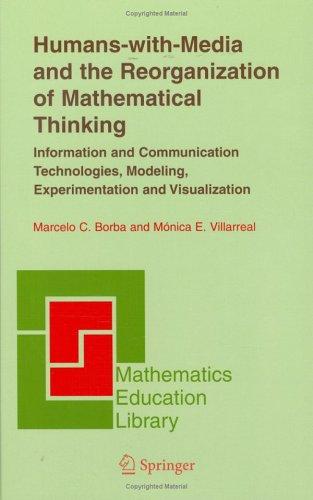
Humans-with-media and the Reorganization of Mathematical Thinking
0
0
As an Amazon Associate and affiliate partner, Menrva Books earns from qualifying purchases. Learn more
Author Description
This book offers a new conceptual framework for reflecting on the role of information and communication technology in mathematics education. Borba and Villarreal provide examples from research conducted at the level of basic and university-level education, developed by their research group based in Brazil, and discuss their findings in the light of the relevant literature. Arguing that different media reorganize mathematical thinking in different ways, they discuss how computers, writing and oral discourse transform education at an epistemological as well as a political level. Modeling and experimentation are seen as pedagogical approaches which are in harmony with changes brought about by the presence of information and communication technology in educational settings. Examples of research about on-line mathematics education courses, and Internet used in regular mathematics courses, are presented and discussed at a theoretical level. In this book, mathematical knowledge is seen as developed by collectives of humans-with-media. The authors propose that knowledge is never constructed solely by humans, but by collectives of humans and technologies of intelligence. Theoretical discussion developed in the book, together with new examples, shed new light on discussions regarding visualization, experimentation and multiple representations in mathematics education. Insightful examples from educational practice open up new paths for the reader.
Menrva's Summary
THE THESIS
This book investigates the transformative impact of information and communication technology (ICT) on mathematical thinking and education. Borba and Villarreal present a novel conceptual framework, drawing on research from Brazil, to explore how various media, including computers, writing, and oral discourse, fundamentally alter mathematical understanding at both epistemological and political levels. They argue that knowledge is co-constructed by collectives of humans and media, proposing that modeling and experimentation are pedagogical approaches that align with the presence of ICT in educational settings. The work examines online courses and internet integration in mathematics, offering new perspectives on visualization, experimentation, and multiple representations.
THE SCOPE MAP
- A new conceptual framework for understanding the role of ICT in mathematics education.
- Examples from basic and university-level research conducted in Brazil.
- Discussion of how computers, writing, and oral discourse reorganize mathematical thinking.
- Analysis of the epistemological and political transformations brought about by ICT.
- Exploration of modeling and experimentation as pedagogical approaches in the digital age.
- Case studies of online mathematics education courses and internet use in regular courses.
- A perspective viewing mathematical knowledge as developed by collectives of humans-with-media.
- Insights into visualization, experimentation, and multiple representations in mathematics education.
THE AUTHORITY PERSPECTIVE
The book is regarded as a significant contribution to the field of mathematics education, particularly for its novel conceptualization of knowledge construction through human-media collectives. Its exploration of how ICT reshapes mathematical thinking at fundamental levels, supported by empirical research, offers valuable insights for educators and researchers. The authors' focus on the epistemological and political dimensions of technology in education provides a critical lens for understanding contemporary learning environments. The work is noted for its theoretical depth and practical examples, opening new avenues for discussion on visualization and representation in mathematics.
Page Count:
232
Publication Date:
2005-01-01
ISBN-10:
0387242635
ISBN-13:
9780387242637
Science & Technology
Non-Fiction
Science
Sociology Of Education
Mathematics Education
Educational Technology
Community Tags
Similar Books