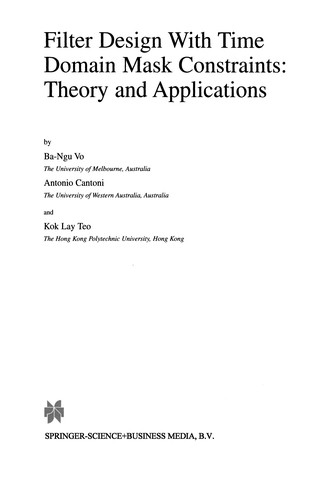
Filter Design With Time Domain Mask Constraints: Theory and Applications
0
0
As an Amazon Associate and affiliate partner, Menrva Books earns from qualifying purchases. Learn more
Author Description
Optimum envelope-constrained filter design is concerned with time-domain synthesis of a filter such that its response to a specific input signal stays within prescribed upper and lower bounds, while minimizing the impact of input noise on the filter output or the impact of the shaped signal on other systems depending on the application. In many practical applications, such as in TV channel equalization, digital transmission, and pulse compression applied to radar, sonar and detection, the soft least square approach, which attempts to match the output waveform with a specific desired pulse, is not the most suitable one. Instead, it becomes necessary to ensure that the response stays within the hard envelope constraints defined by a set of continuous inequality constraints. The main advantage of using the hard envelope-constrained filter formulation is that it admits a whole set of allowable outputs. From this set one can then choose the one which results in the minimization of a cost function appropriate to the application at hand. The signal shaping problems so formulated are semi-infinite optimization problems. This monograph presents in a unified manner results that have been generated over the past several years and are scattered in the research literature. The material covered in the monograph includes problem formulation, numerical optimization algorithms, filter robustness issues and practical examples of the application of envelope constrained filter design. Audience: Postgraduate students, researchers in optimization and telecommunications engineering, and applied mathematicians.
Menrva's Summary
THE THESIS
The core problem addressed is the design of filters with time-domain envelope constraints, moving beyond simpler least-squares methods. This monograph synthesizes research on semi-infinite optimization problems arising in filter design, particularly for applications like TV channel equalization, digital transmission, and radar pulse compression. It focuses on ensuring filter responses remain within hard envelope constraints, allowing for a set of allowable outputs from which an optimal solution can be chosen based on application-specific cost functions. The work covers problem formulation, numerical optimization algorithms, filter robustness, and practical examples.
THE SCOPE MAP
- Problem formulation for envelope-constrained filter design
- Numerical optimization algorithms for semi-infinite problems
- Analysis of filter robustness issues
- Practical examples and applications in telecommunications and radar
- Theoretical foundations for time-domain synthesis of filters
THE AUTHORITY PERSPECTIVE
This monograph is aimed at postgraduate students, researchers in optimization and telecommunications engineering, and applied mathematicians. The subject matter points to a dense, specialist text focusing on theoretical frameworks and algorithmic solutions for complex filter design problems. Its comprehensive coverage of scattered research suggests it serves as a valuable reference for those working in advanced signal processing and optimization.
Page Count:
334
Publication Date:
2001-01-01
ISBN-10:
1441948589
ISBN-13:
9781441948588
Science & Technology
Non-Fiction
Optimization
Applied Mathematics
Community Tags
Similar Books