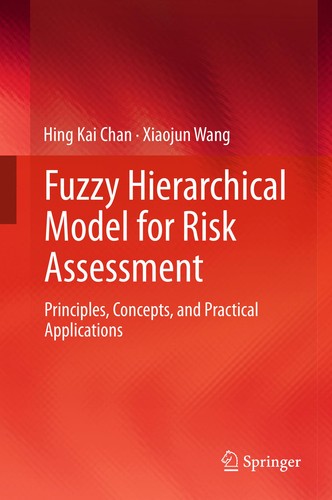
Fuzzy Hierarchical Model for Risk Assessment
0
0
As an Amazon Associate and affiliate partner, Menrva Books earns from qualifying purchases. Learn more
Author Description
Risk management is often complicated by situational uncertainties and the subjective preferences of decision makers. Fuzzy Hierarchical Model for Risk Assessment introduces a fuzzy-based hierarchical approach to solve risk management problems considering both qualitative and quantitative criteria to tackle imprecise information. This approach is illustrated through number of case studies using examples from the food, fashion and electronics sectors to cover a range of applications including supply chain management, green product design and green initiatives. These practical examples explore how this method can be adapted and fine tuned to fit other industries as well. Supported by an extensive literature review, Fuzzy Hierarchical Model for Risk Assessment comprehensively introduces a new method for project managers across all industries as well as researchers in risk management.
Menrva's Summary
THE THESIS
This book introduces a novel fuzzy-based hierarchical approach to risk management that accounts for both qualitative and quantitative criteria to address imprecise information. The author, Hing Kai Chan, presents a method designed to tackle complex decision-making scenarios often complicated by uncertainty and subjective preferences. The approach is rigorously supported by an extensive literature review and is demonstrated through practical case studies from diverse sectors such as food, fashion, and electronics. These examples illustrate its adaptability across various industries, including supply chain management, green product design, and green initiatives, offering a comprehensive tool for project managers and researchers.
THE SCOPE MAP
- Introduction to fuzzy logic and its application in risk assessment.
- Development of a hierarchical model for risk evaluation.
- Integration of qualitative and quantitative criteria in decision-making.
- Case studies from the food, fashion, and electronics industries.
- Applications in supply chain management.
- Applications in green product design and green initiatives.
- Adaptability of the model to different industrial contexts.
- Extensive literature review on risk management and fuzzy systems.
THE AUTHORITY PERSPECTIVE
The book is presented as a comprehensive guide for project managers and researchers in risk management, offering a novel fuzzy-based hierarchical approach. It aims to address the complexities of situational uncertainties and subjective decision-making by integrating qualitative and quantitative criteria. The inclusion of case studies from various sectors demonstrates the practical applicability and adaptability of the proposed method. The work is grounded in an extensive literature review, positioning it as a valuable resource for professionals and academics seeking to enhance risk assessment methodologies.
Page Count:
173
Publication Date:
2013-01-01
ISBN-10:
1447150430
ISBN-13:
9781447150435
Business
Non-Fiction
Decision Making
Product design
Community Tags
Similar Books