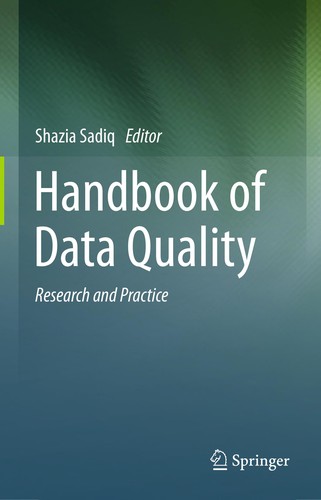
Handbook of Data Quality
0
0
As an Amazon Associate and affiliate partner, Menrva Books earns from qualifying purchases. Learn more
Author Description
The issue of data quality is as old as data itself. However, the proliferation of diverse, large-scale and often publically available data on the Web has increased the risk of poor data quality and misleading data interpretations. On the other hand, data is now exposed at a much more strategic level e.g. through business intelligence systems, increasing manifold the stakes involved for individuals, corporations as well as government agencies. There, the lack of knowledge about data accuracy, currency or completeness can have erroneous and even catastrophic results. With these changes, traditional approaches to data management in general, and data quality control specifically, are challenged. There is an evident need to incorporate data quality considerations into the whole data cycle, encompassing managerial/governance as well as technical aspects.Data quality experts from research and industry agree that a unified framework for data quality management should bring together organizational, architectural and computational approaches. Accordingly, Sadiq structured this handbook in four parts: Part I is on organizational solutions, i.e. the development of data quality objectives for the organization, and the development of strategies to establish roles, processes, policies, and standards required to manage and ensure data quality. Part II, on architectural solutions, covers the technology landscape required to deploy developed data quality management processes, standards and policies. Part III, on computational solutions, presents effective and efficient tools and techniques related to record linkage, lineage and provenance, data uncertainty, and advanced integrity constraints. Finally, Part IV is devoted to case studies of successful data quality initiatives that highlight the various aspects of data quality in action.The individual chapters present both an overview of the respective topic in terms of historical research and/or practice and state of the art, as
Menrva's Summary
THE THESIS
The proliferation of digital data necessitates robust strategies for ensuring its accuracy, currency, and completeness. The increasing reliance on data for critical decisions in business and government, coupled with the challenges posed by large-scale, diverse datasets, highlights the inadequacy of traditional data management approaches. This handbook addresses this gap by proposing a unified framework that integrates organizational, architectural, and computational solutions for data quality management.
THE SCOPE MAP
- Organizational solutions for developing data quality objectives, roles, processes, policies, and standards.
- Architectural solutions covering the technology landscape for deploying data quality management.
- Computational solutions including tools and techniques for record linkage, lineage, provenance, data uncertainty, and advanced integrity constraints.
- Case studies illustrating successful data quality initiatives in practice.
THE AUTHORITY PERSPECTIVE
The book is structured to provide a comprehensive overview of data quality management, addressing both theoretical underpinnings and practical applications. Its four-part organization, moving from organizational to computational aspects and concluding with case studies, suggests a thorough and systematic approach to the subject. The inclusion of both research and industry perspectives indicates an aim to bridge academic theory with real-world implementation challenges.
Page Count:
0
Publication Date:
2020-01-01
ISBN-10:
366260888X
ISBN-13:
9783662608883
Non-Fiction
Science
Science & Technology
Business
Information Science
Community Tags
Similar Books