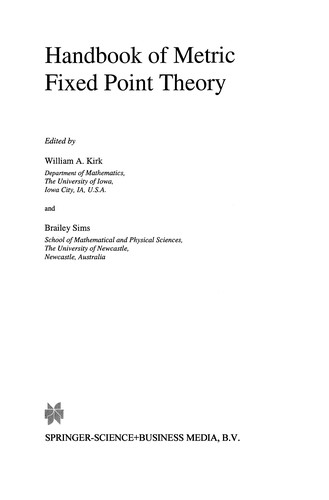
Handbook of Metric Fixed Point Theory
0
0
As an Amazon Associate and affiliate partner, Menrva Books earns from qualifying purchases. Learn more
Author Description
Metric fixed point theory encompasses the branch of fixed point theory which metric conditions on the underlying space and/or on the mappings play a fundamental role. In some sense the theory is a far-reaching outgrowth of Banach's contraction mapping principle. A natural extension of the study of contractions is the limiting case when the Lipschitz constant is allowed to equal one. Such mappings are called nonexpansive. Nonexpansive mappings arise in a variety of natural ways, for example in the study of holomorphic mappings and hyperconvex metric spaces. Because most of the spaces studied in analysis share many algebraic and topological properties as well as metric properties, there is no clear line separating metric fixed point theory from the topological or set-theoretic branch of the theory. Also, because of its metric underpinnings, metric fixed point theory has provided the motivation for the study of many geometric properties of Banach spaces. The contents of this Handbook reflect all of these facts. The purpose of the Handbook is to provide a primary resource for anyone interested in fixed point theory with a metric flavor. The goal is to provide information for those wishing to find results that might apply to their own work and for those wishing to obtain a deeper understanding of the theory. The book should be of interest to a wide range of researchers in mathematical analysis as well as to those whose primary interest is the study of fixed point theory and the underlying spaces. The level of exposition is directed to a wide audience, including students and established researchers.
Menrva's Summary
THE THESIS
This handbook serves as a primary resource for fixed point theory with a metric flavor, exploring its connections to Banach's contraction mapping principle and nonexpansive mappings. The book delves into the theory's outgrowth from Banach's principle, focusing on the limiting case where the Lipschitz constant equals one, defining nonexpansive mappings. It highlights how these mappings appear in contexts such as holomorphic mappings and hyperconvex metric spaces, and discusses the interplay between metric, algebraic, and topological properties of spaces. The text also examines how metric fixed point theory has motivated the study of geometric properties in Banach spaces, aiming to provide results applicable to researchers and a deeper understanding for those interested in the field.
THE SCOPE MAP
- The foundational principles of metric fixed point theory, stemming from Banach's contraction mapping principle.
- Detailed analysis of nonexpansive mappings, including their definition and properties.
- Exploration of the role of metric conditions on spaces and mappings.
- Connections to other branches of fixed point theory, such as topological and set-theoretic approaches.
- The influence of metric fixed point theory on the geometric properties of Banach spaces.
- Applications and examples, including holomorphic mappings and hyperconvex metric spaces.
- Results and insights for researchers and students in mathematical analysis and fixed point theory.
THE AUTHORITY PERSPECTIVE
This handbook is designed as a comprehensive resource for researchers and students interested in metric fixed point theory. Its content reflects the broad scope of the field, from foundational principles to applications in areas like holomorphic mappings and Banach space geometry. The exposition is structured to be accessible to a wide audience, including both established researchers and those new to the subject. The book aims to provide practical results for application and a deeper theoretical understanding.
Page Count:
703
Publication Date:
2001-01-01
ISBN-10:
9048157331
ISBN-13:
9789048157334
Science
Non-Fiction
Analysis
Fixed Point Theory
Research
Metric Spaces
Mathematics
Community Tags
Similar Books