The Hawaiian Goose
0
0
As an Amazon Associate and affiliate partner, Menrva Books earns from qualifying purchases. Learn more
Author Description
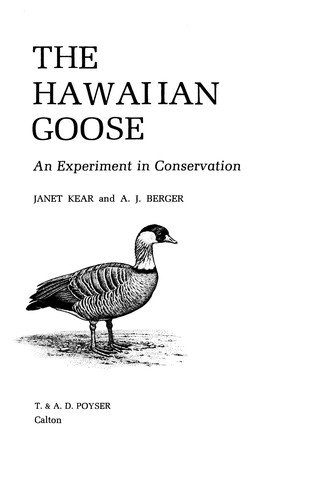
Dr Janet Kear, Assistant Director of the Wildfowl Trust and Curator of its Martin Mere Reserve, and Professor Andrew Berger of the University of Hawaii, have written a timely and absorbing account of the recent history of the Hawaiian Goose, or Nene, its descent to near extinction, its eleventh hour rescue and current restoration to the wild. The species declined from an estimated population of 25,000 in Hawaii in the 18th century to less than fifty birds in the 1940s. Today, thanks largely to the extended breeding programmes at Slimbridge and Pohakuloa, there are probably more than 2000 Hawaiian Geese in the world. The achievement is justly applauded and well-known, but whether this impressive experiment in conservation has been truly successful will not be clear until it becomes evident that the released birds can maintain a breeding population in the wild. As the authors explain, the outcome is far from predictable. The causes which led to the species' decline and the hazards and difficulties faced by the reintroduced population are discussed at length, but the core of the book is the propagation programmes at Slimbridge and Pohakuloa, and the problems and successes they brought during many years of patient work. For the conservationist and aviculturalist the accounts of captive breeding under headings such as infertility, diet, longevity, mortality and the effects of foster mothers, geographical latitude and genetic strain, will be essential reading. Appropriately, Sir Peter Scott, whose imterest and involvement in the rescue of the Hawaiian Goose was of prime importance, is one of the artists whose drawings supplement the text. There is also a colour frontispiece and 24 monochrome plates.--Bloomsbury Publishing.
Menrva's Summary
THE THESIS
The Hawaiian Goose, or Nene, faced a precipitous decline from an estimated 25,000 birds in the 18th century to fewer than fifty in the 1940s. This book chronicles the species' near extinction, its critical rescue through extensive breeding programs at Slimbridge and Pohakuloa, and the ongoing efforts to restore it to the wild. The authors, Dr. Janet Kear and Professor Andrew Berger, detail the challenges and successes of these propagation efforts, examining factors such as infertility, diet, longevity, and the impact of various breeding conditions. The ultimate success of the restoration hinges on the released birds' ability to establish a self-sustaining wild population, a prospect that remains uncertain.
THE SCOPE MAP
- Detailed history of the Hawaiian Goose (Nene) population decline.
- In-depth accounts of captive breeding programs at Slimbridge and Pohakuloa.
- Analysis of factors affecting captive breeding: infertility, diet, longevity, mortality, foster mothers, geographical latitude, and genetic strain.
- Discussion of the hazards and difficulties faced by reintroduced populations.
- Exploration of the unpredictable nature of successful wild population maintenance.
- Contributions from artists, including drawings by Sir Peter Scott.
- Inclusion of a color frontispiece and 24 monochrome plates.
THE AUTHORITY PERSPECTIVE
This work is regarded as essential reading for conservationists and aviculturalists due to its detailed accounts of captive breeding programs and the challenges of species restoration. The authors' expertise as Assistant Director of the Wildfowl Trust and a Professor of the University of Hawaii lends significant authority to the subject matter. The book provides a comprehensive overview of the Nene's near-demise and the intensive efforts undertaken for its recovery. Its focus on the practicalities and uncertainties of conservation makes it a valuable resource for understanding the complexities of reintroduction programs.
Page Count:
154
Publication Date:
1980-01-01
ISBN-10:
1408137577
ISBN-13:
9781408137574
Non-Fiction
Animals
Nature
Zoology
Conservation
Community Tags
Similar Books