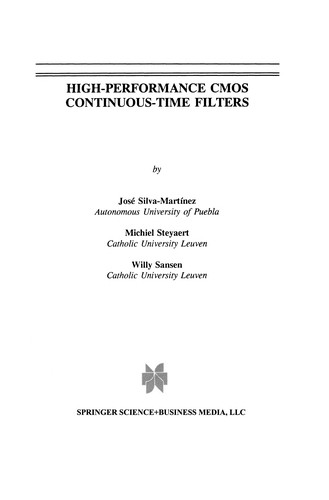
High-Performance CMOS Continuous-Time Filters
0
0
As an Amazon Associate and affiliate partner, Menrva Books earns from qualifying purchases. Learn more
Author Description
High-Performance CMOS Continuous-Time Filters is devoted to the design of CMOS continuous-time filters. CMOS is employed because the most complex integrated circuits have been realized with this technology for two decades. The most important advantages and drawbacks of continuous-time filters are clearly shown. The transfer function is one of the most important filter parameters but several others (like intermodulation distortion, power-supply rejection ratio, noise level and dynamic range) are fundamental in the design of high-performance systems. Special attention is paid to the practical aspects of the design, which shows the difference between an academic design and an industrial design. A clear understanding of the behavior of the circuits and techniques is preferred over complex equations or interpretation of simulated results. Step-by-step design procedures are very often used to clarify the use of the techniques and topologies. The organization of this text is hierarchical, starting with the design consideration of the basic building blocks and ending with the design of several high-performance continuous-time filters. Most of the circuits have been fabricated, theoretically analyzed and simulated, and silicon measurement results are compared with each other. High-Performance CMOS Continuous-Time Filters can be used as a text book for senior or graduate courses on this topic and can also be useful for industrial engineers as a reference book.
Menrva's Summary
THE THESIS
This book investigates the design considerations and practical implementation of continuous-time filters using CMOS technology. It addresses the advantages and drawbacks of continuous-time filters, emphasizing parameters beyond the transfer function, such as distortion, power-supply rejection, noise, and dynamic range. The text prioritizes practical design aspects, differentiating between academic and industrial approaches, and employs step-by-step procedures to clarify techniques and circuit topologies. The content is structured hierarchically, beginning with basic building blocks and progressing to complete filter designs, with many circuits validated through fabrication and silicon measurements.
THE SCOPE MAP
- Design considerations for CMOS continuous-time filters.
- Analysis of advantages and drawbacks of continuous-time filters.
- Key filter parameters: transfer function, intermodulation distortion, power-supply rejection ratio, noise level, and dynamic range.
- Practical aspects of filter design, distinguishing academic from industrial approaches.
- Step-by-step design procedures for techniques and topologies.
- Hierarchical organization from basic building blocks to complete filter designs.
- Comparison of silicon measurement results with theoretical analysis and simulations.
- Application as a textbook for senior/graduate courses or a reference for industrial engineers.
THE AUTHORITY PERSPECTIVE
The book is presented as a valuable resource for both academic and industrial audiences interested in CMOS continuous-time filter design. Its emphasis on practical implementation and detailed design procedures suggests it aims to bridge the gap between theoretical knowledge and real-world application. The inclusion of fabricated circuit results and comparisons with simulations indicates a focus on empirical validation. The hierarchical structure and step-by-step guidance are intended to facilitate learning for students and serve as a practical reference for engineers.
Page Count:
230
Publication Date:
1993-01-01
ISBN-10:
1441951369
ISBN-13:
9781441951366
Science & Technology
Non-Fiction
Science
Engineering
Electronics
Community Tags
Similar Books