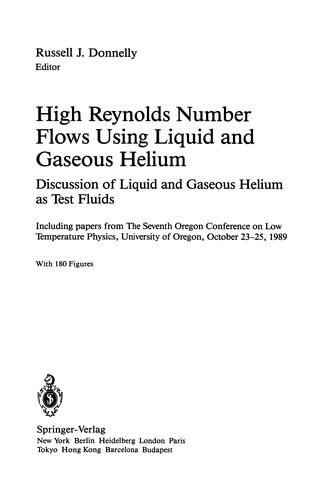
High Reynolds Number Flows Using Liquid and Gaseous Helium
0
0
As an Amazon Associate and affiliate partner, Menrva Books earns from qualifying purchases. Learn more
Author Description
The low viscosity of liquid helium makes it possible to construct compact wind tunnels that can sustain flows with extremely high Reynolds numbers; these would have applications ranging from basic investigations of turbulence to practical testing of supersonic aircraft. Based on papers presented at a workshop held at the University of Oregon in October of 1989, the contributions in this volume discuss both the problems of the design of such wind tunnels and the relevant properties of helium. Contributors include researchers and engineers in condensed-matter physics, fluid dynamics, mathematics, aerospace engineering, computer simulation, and cryogenics. Papers have been brought up to date, and the editor has provided a thorough introduction to the subject and a review of the current state of the art in 1991.
Menrva's Summary
THE THESIS
This volume explores the design and application of wind tunnels utilizing liquid and gaseous helium for high Reynolds number flow studies. The low viscosity of helium enables the creation of compact wind tunnels capable of sustaining extremely high Reynolds numbers, with potential applications spanning fundamental turbulence research to practical supersonic aircraft testing. The book compiles and updates papers from a 1989 workshop, addressing both the engineering challenges of designing these specialized tunnels and the pertinent properties of helium. Contributions come from a diverse group of experts in fields such as condensed-matter physics, fluid dynamics, mathematics, aerospace engineering, computer simulation, and cryogenics.
THE SCOPE MAP
- Design considerations for high Reynolds number wind tunnels using helium.
- Properties of liquid and gaseous helium relevant to fluid dynamics.
- Applications in basic turbulence investigations.
- Practical testing of supersonic aircraft.
- Contributions from researchers and engineers across multiple disciplines.
- Updated papers from a 1989 workshop.
- Editor's introduction and review of the state of the art in 1991.
- Discussions on computer simulation and cryogenics in relation to helium flows.
THE AUTHORITY PERSPECTIVE
The book compiles and updates papers from a 1989 workshop, with contributions from a wide array of specialists in physics, engineering, and mathematics. The editor provides a thorough introduction and a review of the state of the art as of 1991, aiming to bridge the gap between theoretical research and practical application. The focus on high Reynolds number flows using helium suggests a specialized audience interested in advanced fluid dynamics and experimental techniques. The inclusion of diverse disciplinary perspectives indicates a comprehensive approach to the subject matter.
Page Count:
284
Publication Date:
1991-01-01
ISBN-10:
1461231086
ISBN-13:
9781461231080
Science & Technology
Non-Fiction
Science
Aerospace Engineering
Engineering
Physics
Cryogenics
Fluid dynamics
Community Tags
Similar Books