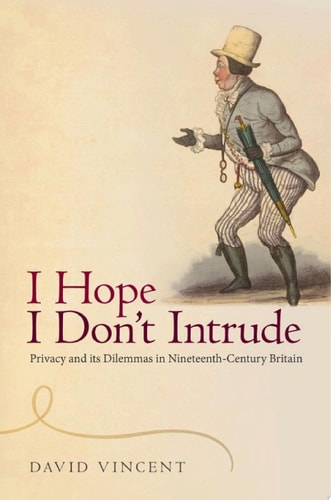
I Hope I Don't Intrude: Privacy and its Dilemmas in Nineteenth-Century Britain
0
0
As an Amazon Associate and affiliate partner, Menrva Books earns from qualifying purchases. Learn more
Author Description
'I Hope I Don't Intrude' takes its title from the catch-phrase of the eponymous hero of the 1825 play Paul Pry, which was an immense success on the London stage and then rapidly in New York and around the English-speaking world. It tackles the complex, multi-faceted subject of privacy in nineteenth-century Britain by examining the way in which the tropes, language, and imagery of the play entered public discourse about privacy in the rest of the century. The volume is not just an account of a play, or of late Georgian and Victorian theatre. Rather it is a history of privacy, showing how the play resonated through Victorian society and revealed its concerns over personal and state secrecy, celebrity, gossip and scandal, postal espionage, virtual privacy, the idea of intimacy, and the evolution of public and private spheres. After 1825 the overly inquisitive figure of Paul Pry appeared everywhere - in songs, stories, and newspapers, and on everything from buttons and Staffordshire pottery to pubs, ships, and stagecoaches - and 'Paul-Prying' rapidly entered the language. 'I Hope I Don't Intrude' is an innovative kind of social history, using rich archival research to trace this cultural artefact through every aspect of its consumer context, and using its meanings to interrogate the largely hidden history of privacy in a period of major transformations in the role of the home, mass communication (particularly the new letter post, which delivered private messages through a public service), and the state. In vivid and entertaining detail, including many illustrations, David Vincent presents the most thorough account yet attempted of a recreational event in an era which saw a decisive shift in consumer markets. His study casts fresh light on the perennial tensions between curiosity and intrusion that were captured in Paul Pry and his catchphrase. Giving a new account of the communications revolution of the period, it re-evaluates the role of the state and the market in creating the modern private individual.
Menrva's Summary
THE THESIS
This book investigates the evolution of privacy in nineteenth-century Britain by analyzing the cultural impact of the 1825 play 'Paul Pry' and its eponymous character. David Vincent, a professor of social history, utilizes the play's pervasive influence as a lens to examine how Victorian society navigated the shifting boundaries between public and private life. By tracing the figure of the intruder across various media and consumer goods, the author argues that the anxieties surrounding surveillance, gossip, and state intervention were central to the era's social transformation.
THE SCOPE MAP
What You Will Find
- An analysis of the cultural diffusion of the 'Paul Pry' archetype in Victorian media and consumer products.
- A historical examination of the development of the postal system and its impact on personal privacy.
- A study of the tensions between state authority, mass communication, and individual intimacy.
Scope Limits
- The analysis is primarily focused on British society and does not provide a comprehensive global history of privacy.
- The text prioritizes the cultural and social history of the nineteenth century over contemporary legal or technological definitions of privacy.
THE AUTHORITY PERSPECTIVE
Historians and scholars of the Victorian era identify this work as a significant contribution to the study of social history and cultural communication. Readers frequently note the meticulous archival research and the author's ability to connect popular entertainment to broader societal shifts in the nineteenth century.
Page Count:
366
Publication Date:
2015-01-01
Publisher:
OUP Oxford
ISBN-10:
0191038148
ISBN-13:
9780191038143
History
Cultural History
Social History
British History
European History
Nineteenth century
Community Tags
Similar Books