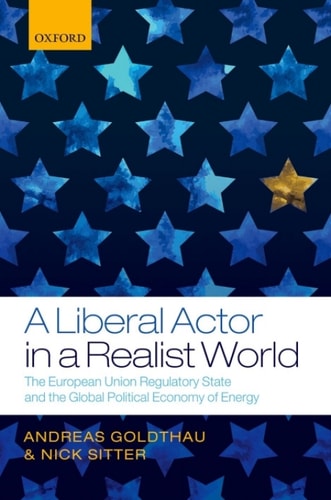
A Liberal Actor in a Realist World: The European Union Regulatory State and the Global Political Economy of Energy
0
0
As an Amazon Associate and affiliate partner, Menrva Books earns from qualifying purchases. Learn more
Author Description
Since 1992, the European Union has put liberalisation at the core of its energy policy agenda. This aspiration was very much in line with an international political economy driven by the neo-liberal (Washington) consensus. The central challenge for the EU is that the energy world has changed, while the EU has not. The rise of Asian energy consumers (China and India), more assertive energy producers (Russia), and the threat of climate change have securitized the IPE of energy, and turned it more 'realist'. The main research question is therefore: 'What does a liberal actor do in a realist world?' The overall answer as far as the EU is concerned is that it approaches energy challenges as a problem of market failure: imperfect competition on the supply side; inadequate supply of public goods on the demand side and in terms of infrastructure; and large externalities that arise both from non-energy events and from large-scale consumption of fossil fuels. A Liberal Actor in a Realist World assesses the changing nature of the global political economy of energy and the European Union's response, and the external dimension of the regulatory state. The book concludes that the EU's soft power has a hard edge, which is derived primarily from its regulatory power. This works best when it targets companies rather than governments, and it is more effective in the 'Near Abroad' than at the global level. This makes the EU emerge an actor in its own right in the global political economy of energy - a 'Regulatory Power Europe'.
Menrva's Summary
THE THESIS
This book investigates how the European Union, as a liberal regulatory actor, navigates a global energy landscape increasingly defined by realist power dynamics and securitization. Andreas Goldthau and Nick Sitter, both experts in international political economy and energy policy, utilize a framework of market failure to analyze the EU's strategic responses. They argue that the EU addresses external energy challenges by treating them as issues of imperfect competition, public goods, and externalities, ultimately projecting power through its regulatory reach rather than traditional geopolitical force.
THE SCOPE MAP
What You Will Find
- Analysis of the shift from the neo-liberal Washington consensus to a more realist global energy order.
- Examination of the EU's regulatory state model applied to energy markets.
- Case studies on the effectiveness of EU soft power in the 'Near Abroad' versus global markets.
Scope Limits
- The text does not provide a comprehensive history of all individual EU member state energy policies.
- It does not offer a predictive model for future climate change mitigation technologies.
THE AUTHORITY PERSPECTIVE
Experts identify this work as a significant contribution to the study of 'Regulatory Power Europe' and its application to energy security. Readers frequently note the academic density of the prose, which is well-suited for scholars and policy analysts interested in the intersection of market regulation and international relations.
Page Count:
192
Publication Date:
2015-01-01
Publisher:
OUP Oxford
ISBN-10:
0191030287
ISBN-13:
9780191030284
Public Policy
International relations
European Union
Energy policy
European
Community Tags
Similar Books