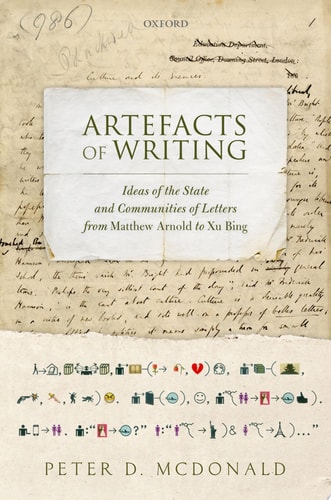
Artefacts of Writing
0
0
As an Amazon Associate and affiliate partner, Menrva Books earns from qualifying purchases. Learn more
Author Description
Some forms of literature interfere with the workings of the literate brain, posing a challenge to readers of all kinds, including professional literary critics. In Artefacts of Writing, Peter D. McDonald argues they pose as much of a challenge to the way states conceptualise language, culture, and community. Drawing on a wealth of evidence, from Victorian scholarly disputes over the identity of the English language to the constitutional debates about its future in Ireland, India, and South Africa, and from the quarrels over the idea of culture within the League of Nations in the interwar years to UNESCO's ongoing struggle to articulate a viable concept of diversity, McDonald brings together a large ensemble of legacy writers, including T.S. Eliot, James Joyce, and Rabindranath Tagore, putting them in dialogue with each other and with the policy-makers who shaped the formation of modern states and the history of internationalist thought from the 1860s to the 1940s. In the second part of the book, he reflects on the continuing evolution of these dialogues, showing how a varied array of more contemporary writers from Amit Chaudhuri, J. M. Coetzee, and Salman Rushdie to Antjie Krog, Arvind Krishna Mehrotra, and Es'kia Mphahlele cast new light on a range of questions concerning education, literacy, human rights, translation, indigenous knowledge, and cultural diversity that have preoccupied UNESCO since 1945. At once a novel contribution to institutional and intellectual history and an innovative exercise in literary and philosophical analysis, Artefacts of Writing affords a unique perspective on literature's place at the centre of some of the most fraught, often lethal public controversies that defined the long-twentieth century and that continue to haunt us today.
Menrva's Summary
THE THESIS
This book investigates how specific forms of literature challenge the ways in which modern states conceptualize language, culture, and community. Peter D. McDonald, a scholar of literature and history, utilizes a vast array of archival evidence and institutional records to demonstrate how literary works have historically intersected with policy-making. He argues that literature is not merely an aesthetic object but a central component in the formation of modern states and internationalist thought from the 1860s to the present.
THE SCOPE MAP
What You Will Find
- Historical analysis of Victorian scholarly disputes regarding the English language.
- Examination of constitutional debates in Ireland, India, and South Africa.
- Institutional history of the League of Nations and UNESCO's cultural policies.
- Comparative analysis of writers such as T.S. Eliot, James Joyce, Rabindranath Tagore, J.M. Coetzee, and Salman Rushdie.
- Philosophical inquiry into education, literacy, human rights, and indigenous knowledge.
Scope Limits
- The text focuses primarily on the intersection of literature and state-level institutional policy rather than providing a comprehensive literary biography of the authors mentioned.
- It does not offer a prescriptive guide for current cultural policy but rather a historical and analytical account of past and ongoing debates.
THE AUTHORITY PERSPECTIVE
Scholars and critics recognize this work as a dense, interdisciplinary study that bridges the gap between literary analysis and institutional history. Readers frequently note the academic rigor of the prose, highlighting its value for those interested in the political dimensions of global literature and internationalist thought.
Page Count:
328
Publication Date:
2017-01-01
Publisher:
Oxford University Press
ISBN-10:
0191038261
ISBN-13:
9780191038266
Education - History
Literary Criticism
Intellectual History
Community Tags
Similar Books