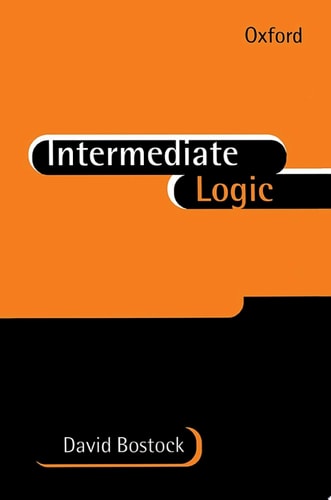
Intermediate Logic
0
0
As an Amazon Associate and affiliate partner, Menrva Books earns from qualifying purchases. Learn more
Author Description
Intermediate Logic is an ideal text for anyone who has taken a first course in logic and is progressing to further study. It examines logical theory, rather than the applications of logic, and does not assume any specific technological grounding. The author introduces and explains each concept and term, ensuring that readers have a firm foundation for study. He provides a broad, deep understanding of logic by adopting and comparing a variety of different methods and approaches. In the first section, Bostock covers such fundamental notions as truth, validity, entailment, quantification, and decision procedures. Part two lays out a definitive introduction to four key logical tools or procedures: semantic tableaux, axiomatic proofs, natural deduction, and sequent calculi. The final section opens up new areas of existence and identity, concluding by moving from orthodox logic to examination of `free logic'. Intermediate Logic provides an ideal secondary course in logic for university students, and a bridge to advanced study of such subjects as model theory, proof theory, and other specialized areas of mathematical logic.
Menrva's Summary
THE THESIS
This text investigates the theoretical foundations of logic for students who have completed an introductory course. David Bostock, a scholar in the field, utilizes a comparative methodology to explain logical theory without requiring prior technical or technological expertise.
THE SCOPE MAP
What You Will Find
- Fundamental concepts including truth, validity, entailment, and quantification.
- Comparative analysis of semantic tableaux, axiomatic proofs, natural deduction, and sequent calculi.
- Advanced topics such as existence, identity, and free logic.
Scope Limits
- The text focuses on logical theory rather than practical applications of logic.
- It does not provide an exhaustive survey of all branches of mathematical logic.
THE AUTHORITY PERSPECTIVE
Experts and educators frequently cite this work as a bridge between introductory logic and advanced study in model or proof theory. Readers often note the clarity of the prose and the effectiveness of the comparative approach in building a firm foundation for further academic inquiry.
Page Count:
403
Publication Date:
1997-01-01
Publisher:
Clarendon Press
ISBN-10:
0191037222
ISBN-13:
9780191037221
Politics
Philosophy
Mathematics
Kindle eBooks
Academic
Kindle Store
textbook
Logic
Logic & Critical Reasoning
Categories