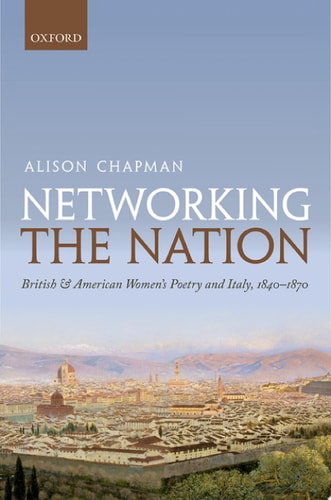
Networking the Nation: British and American Women's Poetry and Italy, 1840-1870
0
0
As an Amazon Associate and affiliate partner, Menrva Books earns from qualifying purchases. Learn more
Author Description
How did nineteenth-century women's poetry shift from the poetess poetry of lyric effusion and hyper-femininity to the muscular epic of Elizabeth Barrett Browning's Aurora Leigh? Networking the Nation re-writes women's poetic traditions by demonstrating the debt that Barrett Browning's revolutionary poetics owed to a circle of American and British women poets living in Florence and campaigning in their poetry and in their salons for Italian Unification. These women poets--Isa Blagden, Elizabeth Kinney, Eliza Ogilvy, and Theodosia Garrow Trollope--formed with Barrett Browning a network of poetry, sociability, and politics, which was devoted to the mission of campaigning for Italy as an independent nation state. In their poetic experiments with the active lyric voice, in their forging of a transnational persona through the periodical press, in their salons and spiritualist séances, the women poets formed a network that attempted to assert and perform an independent unified Italy in their work. Networking the Nation maps the careers of these expatriate women poets who were based in Florence in the key years of Risorgimento politics, racing their transnational social and print communities, and the problematic but schismatic shift in their poetry from the conventional sphere of the poetess. In the fraught and thrilling engagement with their adopted nation's revolutionary turmoil, and in their experiments with different types of writing agency, the women poets in this book offer revolutions of other kinds: revolutions of women's poetry and the very act of writing.
Menrva's Summary
THE THESIS
This book investigates how a circle of expatriate British and American women poets in Florence influenced the development of nineteenth-century poetic traditions through their political engagement with the Italian Risorgimento. Alison Chapman, a scholar of Victorian literature, utilizes archival research and analysis of periodical press contributions to argue that these women moved beyond the conventional 'poetess' tradition toward a more active, transnational, and politically charged lyric voice. By examining the intersection of salons, spiritualism, and revolutionary politics, the text posits that these poets collectively redefined the agency of women's writing during a period of intense national transformation.
THE SCOPE MAP
What You Will Find
- Analysis of the poetic works of Isa Blagden, Elizabeth Kinney, Eliza Ogilvy, and Theodosia Garrow Trollope.
- Examination of the influence of Elizabeth Barrett Browning's 'Aurora Leigh' on the collective poetic network.
- Investigation into the role of salons and spiritualist séances as sites of political and literary production.
- Study of the impact of the periodical press on the formation of a transnational female persona.
Scope Limits
- The study is geographically focused on the expatriate community in Florence.
- The chronological scope is strictly limited to the years 1840 to 1870.
THE AUTHORITY PERSPECTIVE
Scholars recognize this work as a significant contribution to the study of Victorian transnationalism and the evolution of women's poetic forms. The text is noted for its rigorous archival approach and its ability to synthesize complex political history with literary analysis.
Page Count:
304
Publication Date:
2015-01-01
Publisher:
OUP Oxford
ISBN-10:
0191035459
ISBN-13:
9780191035456
Poetry
English
Italian History
English & College Success
Womens Studies
Literary Criticism
Nineteenth century
Women Poets
English poetry
Community Tags
Similar Books