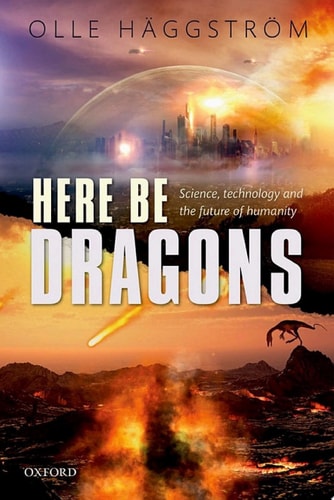
Here Be Dragons: Science, Technology and the Future of Humanity
0
0
As an Amazon Associate and affiliate partner, Menrva Books earns from qualifying purchases. Learn more
Author Description
There is a widely held conception that progress in science and technology is our salvation, and the more of it, the better. This, however, is an oversimplified and even dangerous attitude. While the future will certainly offer huge changes due to such progress, it is far from certain that all of these changes will be for the better. The unprecedented rate of technological development that the 20th century witnessed has made our lives today vastly different from those in 1900. No slowdown is in sight, and the 21st century will most likely see even more revolutionary changes than the 20th, due to advances in science, technology and medicine. Particular areas where extraordinary and perhaps disruptive advances can be expected include biotechnology, nanotechnology, and machine intelligence. We may also look forward various ways to enhance human cognitive and other abilities using, e.g., pharmaceuticals, genetic engineering or machine-brain interfaces - perhaps to the extent of changing human nature beyond what we currently think of as human, and into a posthuman era. The potential benefits of all these technologies are enormous, but so are the risks, including the possibility of human extinction. This book is a passionate plea for doing our best to map the territories ahead of us, and for acting with foresight, so as to maximize our chances of reaping the benefits of the new technologies while avoiding the dangers.
Menrva's Summary
THE THESIS
This book investigates whether the rapid, unchecked advancement of science and technology poses an existential threat to humanity rather than serving as an inherent guarantee of progress. Olle Häggström, a professor of mathematical statistics, utilizes his background in risk assessment and scientific analysis to argue that society must adopt a more cautious, foresight-driven approach to emerging technologies. He contends that the potential for human extinction via biotechnology, nanotechnology, and artificial intelligence necessitates a shift from blind optimism to rigorous, proactive risk management.
THE SCOPE MAP
What You Will Find
- Analysis of existential risks associated with biotechnology and nanotechnology
- Examination of machine intelligence and the potential for posthuman evolution
- Frameworks for evaluating the ethical implications of human cognitive enhancement
- Arguments for institutionalizing long-term foresight in scientific policy
Scope Limits
- Does not provide a comprehensive technical manual for specific engineering solutions
- Does not focus on short-term political or economic policy debates
THE AUTHORITY PERSPECTIVE
Experts in the field of existential risk and philosophy of technology frequently cite this work as a clear, accessible introduction to the dangers of unbridled scientific advancement. Readers often note the academic rigor of the prose, which balances technical concern with a call for societal responsibility.
Page Count:
288
Publication Date:
2016-01-01
Publisher:
OUP Oxford
ISBN-10:
0191035408
ISBN-13:
9780191035401
Science
Future Studies
Mathematics Statistics
Philosophy of
Technology
Ethics
Mathematics - General
Technology and civilization
Sociology
Community Tags
Similar Books