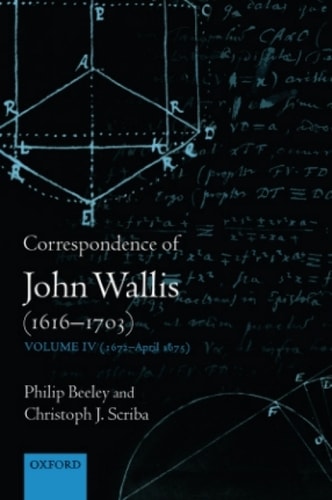
Correspondence of John Wallis (1616-1703): Volume IV (1672-April 1675)
0
0
As an Amazon Associate and affiliate partner, Menrva Books earns from qualifying purchases. Learn more
Author Description
The Correspondence of John Wallis (1616 -1703) is a critically acclaimed resource in the history of early modern science. Volume IV covers the period from 1672 to April 1675 and contains over eighty previously unpublished letters. It documents Wallis's role in the crucial debate over the method of tangents involving figures such as Sluse, James Gregory, Hudde, Barrow, Newton, and Christiaan Huygens. In this way it illuminates further an important part of the history of the calculus. Wallis's letters also provide valuable new insights into mathematical book production and the importance of the international exchange of books in the growth and dissemination of mathematical knowledge. We learn more about the part played by the intelligencer John Collins and the astronomer royal John Flamsteed in the edition of Jeremiah Horrox's Opera posthuma, published by Wallis in 1673. There are also new insights on the background to Wallis's early work on equations, and the reasons why he criticized Gaston Pardies's proposed tract on motion. The causes of the breakdown in Wallis's epistolary relation to Christiaan Huygens following the publication of the Horologium oscillatorium in 1673 are also revealed. Many letters reflect Wallis's active involvement in the Royal Society. Through the medium of correspondence the Savilian professor participated in numerous debates such as those over the anomalous suspension of mercury in the Torricellian tube or Hevelius's use of plain sights in positional astronomy. The volume allows us to gain a deeper understanding of the background to these debates. Furthermore, the volume throws important new light on the history of the University of Oxford and of the University Press in the early modern period. As keeper of the University Archives, Wallis was one of the institution's highest officers. Scarcely any event of note concerning the University did not require his involvement in some way, and this is reflected in numerous letters and documents whic
Menrva's Summary
THE THESIS
This volume investigates the intellectual and institutional networks of the seventeenth century through the lens of John Wallis’s professional correspondence. Editors Philip Beeley and Christoph J. Scriba utilize these primary source documents to map the development of early calculus and the collaborative nature of the Royal Society. The text argues that Wallis served as a central node in the dissemination of mathematical knowledge and university administration during a period of rapid scientific advancement.
THE SCOPE MAP
What You Will Find
- Primary source letters covering the period from 1672 to April 1675
- Documentation regarding the debate over the method of tangents
- Insights into the publication history of Jeremiah Horrox’s Opera posthuma
- Records of administrative activities at the University of Oxford and the University Press
Scope Limits
- The volume is restricted to the specific timeframe of 1672–1675
- It does not provide a comprehensive biography of Wallis outside of this specific epistolary context
THE AUTHORITY PERSPECTIVE
Scholars and historians of science recognize this series as a foundational resource for understanding the mechanics of seventeenth-century mathematical exchange. Readers frequently note the high level of academic density and the meticulous editorial rigor applied to the transcription and contextualization of these documents.
Page Count:
656
Publication Date:
2014-01-01
Publisher:
OUP Oxford
ISBN-10:
0191030694
ISBN-13:
9780191030697
Biography
History
Science History
Earth Sciences
Academic
Mathematics
Correspondence
History - Modern
Community Tags
Similar Books


Reader Comments
Share Your Thoughts
No comments yet. Be the first to share your thoughts!