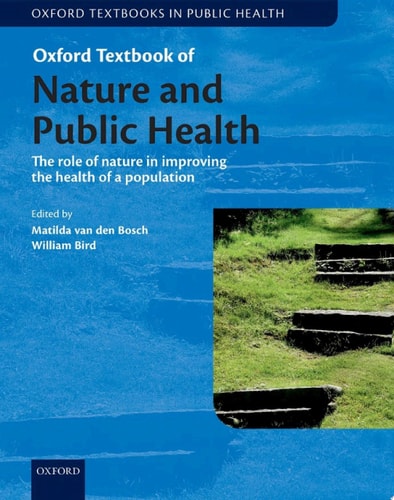
Oxford Textbook of Nature and Public Health: The Role of Nature in Improving the Health of a Population
0
0
As an Amazon Associate and affiliate partner, Menrva Books earns from qualifying purchases. Learn more
Author Description
Human beings have always been affected by their surroundings. There are various health benefits linked to being able to access to nature; including increased physical activity, stress recovery, and the stimulation of child cognitive development. The Oxford Textbook of Nature and Public Health provides a broad and inclusive picture of the relationship between our own health and the natural environment. All aspects of this unique relationship are covered, ranging from disease prevention through physical activity in green spaces to innovative ecosystem services, such as climate change adaptation by urban trees. Potential hazardous consequences are also discussed including natural disasters, vector-borne pathogens, and allergies. This book analyses the complexity of our human interaction with nature and includes sections for example epigenetics, stress physiology, and impact assessments. These topics are all interconnected and fundamental for reaching a full understanding of the role of nature in public health and wellbeing. Much of the recent literature on environmental health has primarily described potential threats from our natural surroundings. The Oxford Textbook of Nature and Public Health instead focuses on how nature can positively impact our health and wellbeing, and how much we risk losing by destroying it. The all-inclusive approach provides a comprehensive and complete coverage of the role of nature in public health, making this textbook invaluable reading for health professionals, students, and researchers within public health, environmental health, and complementary medicine.
Menrva's Summary
THE THESIS
This text investigates the multifaceted relationship between human health and the natural environment, specifically focusing on how nature serves as a determinant for population wellbeing. Editors Matilda van den Bosch and William Bird, both established experts in environmental health and public health, synthesize current research to argue that nature is not merely a passive backdrop but an active component of health promotion. The book utilizes a multidisciplinary framework, incorporating data from fields such as epigenetics, stress physiology, and urban planning to demonstrate the physiological and psychological benefits of nature exposure.
THE SCOPE MAP
What You Will Find
- Analysis of health benefits including physical activity, stress recovery, and cognitive development.
- Examination of ecosystem services such as climate change adaptation via urban forestry.
- Discussion of environmental hazards including vector-borne pathogens and natural disasters.
- Methodologies for conducting health impact assessments related to green space.
Scope Limits
- The text does not focus on clinical treatment of specific diseases but rather on population-level health determinants.
- It does not provide exhaustive coverage of non-natural environmental pollutants or industrial toxins.
THE AUTHORITY PERSPECTIVE
Experts recognize this volume as a comprehensive reference for professionals and students navigating the intersection of environmental science and public health. Readers frequently note the academic density of the prose, which serves as a foundational resource for those seeking to integrate nature-based solutions into public health policy.
Page Count:
360
Publication Date:
2018-01-01
Publisher:
OUP Oxford
ISBN-10:
0191038768
ISBN-13:
9780191038761
Ecology
Allied Health
Public Health
Environmental Health
Medicine
urban planning
Medical
Community Tags
Similar Books