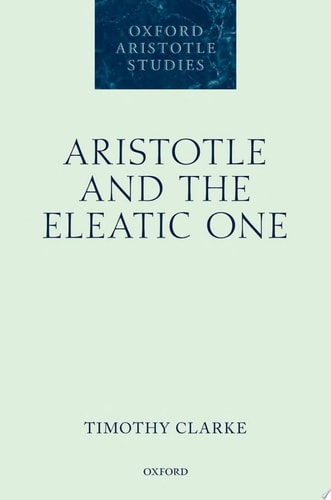
Aristotle and the Eleatic One
0
0
As an Amazon Associate and affiliate partner, Menrva Books earns from qualifying purchases. Learn more
Author Description
In this book Timothy Clarke examines Aristotle's response to Eleatic monism, the theory of Parmenides of Elea and his followers that reality is 'one'. Clarke argues that Aristotle interprets the Eleatics as thoroughgoing monists, for whom the pluralistic, changing world of the senses is a mere illusion. Understood in this way, the Eleatic theory constitutes a radical challenge to the possibility of natural philosophy. Aristotle discusses the Eleatics in several works, including De Caelo, De Generatione et Corruptione, and the Metaphysics. But his most extensive treatment of their monism comes at the beginning of the Physics, where he criticizes them for overlooking the fact that 'being is said in many ways' - in other words, that there are many ways of being. Through a careful analysis of this and other criticisms, Clarke explains how Aristotle's engagement with the Eleatics prepares the ground for his own theory of the principles of nature. Aristotle is commonly thought to be an unreliable interpreter of his Presocratic predecessors; in contrast, this book argues that his critique can shed valuable light on the motivation of the Eleatic theory and its influence on the later philosophical tradition.
Menrva's Summary
THE THESIS
This book investigates how Aristotle’s critique of Eleatic monism serves as a foundational element in the development of his own natural philosophy. Timothy Clarke, a scholar of ancient philosophy, utilizes a rigorous textual analysis of Aristotle’s major works to argue that the Stagirite’s engagement with Parmenides and his followers is more nuanced and philosophically significant than traditional interpretations suggest. By examining the claim that 'being is said in many ways,' Clarke demonstrates how Aristotle addresses the Eleatic challenge to the reality of change and plurality.
THE SCOPE MAP
What You Will Find
- Detailed analysis of Aristotle’s Physics, De Caelo, De Generatione et Corruptione, and Metaphysics.
- Examination of the Eleatic theory of monism as a challenge to natural philosophy.
- Argumentation regarding Aristotle’s role as an interpreter of Presocratic thought.
Scope Limits
- The text does not provide a general history of Presocratic philosophy outside of its relation to Aristotle.
- It does not focus on the reception of Eleaticism in post-Aristotelian schools of thought.
THE AUTHORITY PERSPECTIVE
Scholars recognize this work as a significant contribution to the Oxford Aristotle Studies series, noting its precise textual focus and its challenge to the common view of Aristotle as a dismissive historian of philosophy. Readers frequently highlight the academic density of the prose, which is intended for specialists in ancient metaphysics and Aristotelian scholarship.
Page Count:
241
Publication Date:
2019-01-01
Publisher:
OUP Oxford
ISBN-10:
0191030457
ISBN-13:
9780191030451
Philosophy
Academic
Metaphysics
Presocratic Philosophy
Aristotle
History & Surveys
Eleatics