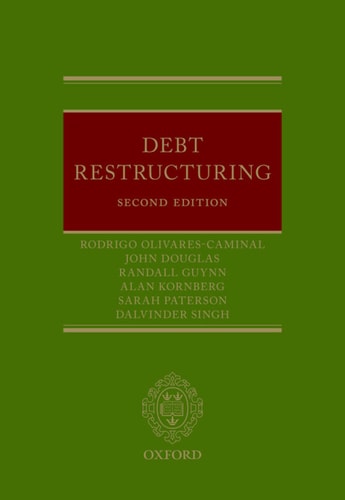
Debt Restructuring
0
0
As an Amazon Associate and affiliate partner, Menrva Books earns from qualifying purchases. Learn more
Author Description
The new second edition of Debt Restructuring provides detailed legal analysis of international corporate, banking, and sovereign debt restructuring, from the perspective of both creditors and debtors. It sets out practical guidance to help practitioners, policy-makers and academics to understand current developments in debt restructuring, and provides solutions for creditors holding distressed debt and debtor options in a distressed scenario. The Corporate Debt section includes a number of very significant changes such as the UK Supreme Court decision in Eurosail and the disapproval of the "point of no return" test for balance sheet insolvency or the endorsement of the Cheyne Finance decision on cashflow. The changes in treatment of schemes of arrangement since with the decision in Rodenstock are reflected as are the Recast European Insolvency Regulation (EIR) and the Supreme Court decision in Rubin. In the US chapter the new edition considers the limitations on bankruptcy court jurisdiction in Stern v. Marshall and, in the RadLax case, the right of secured creditors to credit bid in a sale of their collateral under a chapter 11 plan. Other significant case law includes consideration of the various safe harbour provisions of the Bankruptcy Code relating to derivative and other financial instruments and cases concerning the effect of foreign court orders in the US. In the Bank Resolution section, the UK part also has been substantially amended to reflect the new system of macro and micro prudential oversight with the establishment of the PRA, FCA, FPC, and the FSCS. Additionally it reflects changes introduced by the Financial Services Act 2012 and by the Financial Services (Banking Reform) Act 2013. Additionally there is a new chapter in this part on the EU framework on the resolution of banks and financial institutions which analyses and explains initiatives such as SRM, and the Bank Recovery and Resolution Directive. The US chapter reflects changes in Fannie and Fr
Menrva's Summary
THE THESIS
This text investigates the complex legal frameworks and practical mechanisms governing the restructuring of corporate, banking, and sovereign debt in international markets. The authors, a team of experienced legal practitioners and academics, synthesize case law and statutory developments to provide a comprehensive guide for navigating distressed debt scenarios. By examining both creditor rights and debtor options, the book establishes a framework for understanding the evolving regulatory landscape in the UK, the US, and the European Union.
THE SCOPE MAP
What You Will Find
- Legal analysis of corporate, banking, and sovereign debt restructuring protocols.
- Examination of UK insolvency precedents including Eurosail, Rodenstock, and Rubin.
- Review of US Bankruptcy Code provisions, including Chapter 11 plans and safe harbor rules.
- Overview of the EU framework for bank resolution, including the Bank Recovery and Resolution Directive.
Scope Limits
- The text focuses primarily on legal and regulatory mechanisms rather than macroeconomic theory.
- It does not provide exhaustive coverage of every global jurisdiction, focusing instead on key financial hubs.
THE AUTHORITY PERSPECTIVE
Legal practitioners and academics frequently cite this work as a comprehensive reference for navigating the technical complexities of international insolvency law. Experts highlight the text's utility in bridging the gap between high-level policy changes and the practical application of debt restructuring strategies.
Page Count:
616
Publication Date:
2016-01-01
Publisher:
OUP Oxford
ISBN-10:
0191038350
ISBN-13:
9780191038358
Categories
Law
Franchising
Kindle Store
Insolvency
Kindle eBooks
Corporate Law
Finance
Banking
International Law
Debt relief
Bankruptcy
Community Tags
Similar Books












Reader Comments
Share Your Thoughts
No comments yet. Be the first to share your thoughts!