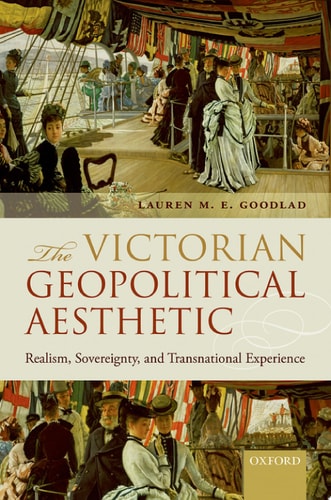
The Victorian Geopolitical Aesthetic: Realism, Sovereignty, and Transnational Experience
0
0
As an Amazon Associate and affiliate partner, Menrva Books earns from qualifying purchases. Learn more
Author Description
How did realist fiction alter in the effort to craft forms and genres receptive to the dynamism of an expanding empire and globalizing world? Do these nineteenth-century variations on the "geopolitical aesthetic" continue to resonate today? Crossing literary criticism, political theory, and longue durée history, The Victorian Geopolitical Aesthetic explores these questions from the standpoint of nineteenth-century novelists such as Wilkie Collins, George Eliot, Gustave Flaubert, and Anthony Trollope, as well as successors including E. M. Forster and the creators of recent television serials. By looking at the category of "sovereignty" at multiple scales and in diverse contexts, Lauren M. E. Goodlad shows that the ideological crucible for "high" realism was not a hegemonic liberalism. It was, rather, a clash of modern liberal ideals struggling to distintricate themselves from a powerful conservative vision of empire while striving to negotiate the inequalities of power which a supposedly universalistic liberalism had helped to generate. The material occasion for the Victorian era's rich realist experiments was the long transition from an informal empire of trade that could be celebrated as liberal to a neo-feudal imperialism that only Tories could warmly embrace. The book places realism's geopolitical aesthetic at the heart of recurring modern experiences of breached sovereignty, forgotten history, and subjective exile. The Coda, titled "The Way We Historicize Now", concludes the study with connections to recent debates about "surface reading", "distant reading", and the hermeneutics of suspicion.
Menrva's Summary
THE THESIS
How did the evolution of realist fiction reflect the complex tensions between nineteenth-century imperial expansion, liberal ideology, and the shifting nature of global sovereignty? Lauren M. E. Goodlad, a scholar of Victorian literature and culture, investigates the intersection of literary form and geopolitical reality. She argues that high realism emerged not from a unified liberal consensus, but from a volatile struggle to reconcile liberal ideals with the realities of neo-feudal imperialism and systemic inequality. By examining the works of canonical novelists alongside contemporary media, the author demonstrates how these aesthetic experiments continue to inform modern understandings of power and exile.
THE SCOPE MAP
What You Will Find
- Analysis of nineteenth-century realist novelists including Wilkie Collins, George Eliot, Gustave Flaubert, and Anthony Trollope.
- Examination of the transition from informal trade-based empire to neo-feudal imperialism.
- Theoretical frameworks connecting literary realism to political concepts of sovereignty and transnational experience.
- A concluding Coda addressing contemporary methodological debates in literary studies such as surface reading and distant reading.
Scope Limits
- The study does not provide an exhaustive survey of all Victorian literature, focusing instead on specific authors who exemplify the geopolitical aesthetic.
- The analysis does not attempt to resolve modern geopolitical conflicts, but rather to historicize the aesthetic frameworks through which they are perceived.
THE AUTHORITY PERSPECTIVE
Scholars and critics recognize this work as a rigorous contribution to the field of Victorian studies, noting its dense synthesis of political theory and literary history. Readers frequently highlight the author's ability to bridge the gap between nineteenth-century realist experiments and contemporary debates in literary methodology.
Page Count:
368
Publication Date:
2015-01-01
Publisher:
OUP Oxford
ISBN-10:
0191044008
ISBN-13:
9780191044007
History
Literary Criticism
In literature
Realism
19th Century
Indigenous
Political Theory
Community Tags
Similar Books